Nature
 PUBLISHED
 2
2


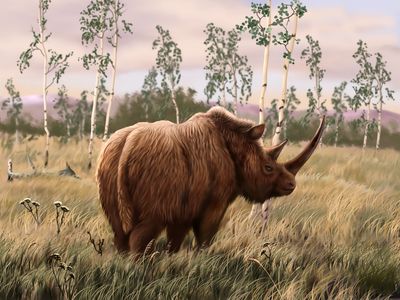


Russian scientists have recently studied a 32,400-year-old woolly rhinoceros that’s been preserved in permafrost like a prehistoric popsicle, revealing a bunch of new insights into the extinct species.
The frozen carcass of the woolly rhino was unearthed in the summer of 2020 near the banks of the Tirekhtyakh River in Russia’s far eastern Sakha Republic. They nicknamed it the “Abyisky rhinoceros” after the district of its discovery.
Despite dating to around 32,400 years ago, much of the animal’s soft tissues, skin, and wool remained intact in the sub-zero permafrost, providing scientists with an incredible opportunity to study its anatomy.
In a new study, researchers revealed that the wooly rhino was only young, perhaps not older than 4.5 years old when it died (see pictures here).
Its youthful age is also seen in its woolly hair, which is short and relatively light, compared to the thick, dark hair of older individuals. Embedded within its wool, the team uncovered evidence of tiny parasitic crustaceans called water fleas, which are not found in the region today.
The most significant find was a fatty hump on the back of the woolly rhino, described as an “anatomical peculiarity” that’s never been physically identified on the species before.
Similar fatty deposits are seen in woolly mammoths, another extinct animal of Eurasia that had to brave the frosty conditions of the Ice Age. Perhaps, just like the blubber of modern-day animals living in cold environments, the fat acted like a thermal insulator or an energy reserve for periods of plight.
The woolly rhinoceros (Coelodonta antiquitatis) was a large, herbivorous mammal that stomped around the northern regions of Eurasia, particularly Siberia, from about 3.6 million years ago to its extinction around 10,000 years ago.
They were prolific in their heyday, but just six preserved wooly rhino bodies have been found in the Sakha Republic since the late 18th century, the latest of which was recovered in Oymyakonsky District a few months ago.
One of the most remarkable and famous specimens was recovered in 2014/2015. Called “Sasha,” the young wooly rhino had a thick strawberry-blonde coat that revealed how the animals were fully adapted to the cold climate from a young age.
Along with rhinos, several other species have been excavated from the region’s permafrost, including mammoths, wolves, cave lions, and birds. As the world warms due to climate change, it’s expected that many more specimens could be revealed by thawing permafrost. However, it’s somewhat of a race against time; once the specimens are uncovered and exposed to the elements, they will quickly degrade and be unfit for scientific research.
The new study is published in the journal Doklady Earth Sciences.