Technology
 PUBLISHED
 5
5


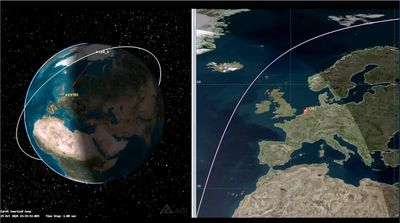


The European Space Agency (ESA) and Telesat have achieved a world-first by connecting a Low Earth Orbit (LEO) satellite to the ground using 5G Non-Terrestrial Network (NTN) technology. This marks a significant step towards establishing space-based communications that are as easy as using a smartphone. The development could revolutionize how emergency responses coordinate, provide better rural healthcare, and even support industrial operations across the world, even in remote or typically underserved areas.
Earlier this year, ESA and Telesat signed a Memorandum of Understanding which offered the former access to the LEO 3 satellite operated by the latter. This satellite serves an important role in low-latency customer applications testing – a process that evaluates and ensures the performance and responsiveness of applications that are sensitive to delays or “latency” – as well as antenna and modern developments.
The team used Amarisoft’s 5G technology which they managed to connect with the satellite as it was moving across the sky, from the horizon to its peak elevation of 38 degrees and down again. The connection remained stable throughout this time.
Although other experiments have been conducted with satellites in geostationary orbits, this is the first time a 5G NTN technology has been connected with a LEO satellite moving quickly in respect to a user on the ground.
The opportunities this achievement opens up should not be downplayed. It offers new chances to perform remote surgery through reliable telehealth services, support autonomous vehicles, provide connectivity for disaster response teams, connect civilians who live or are located in remote places, and can enhance in-flight internet services.
“This world-first experiment demonstrates ESA’s technical excellence in advancing broadband satellite access technology,” Alberto Ginesi, ESA’s Head of the Telecom Systems and Techniques Section of the Directorate of Technology, Engineering, and Quality (TEC) explained in a statement.
“Building on the 3GPP standardisation groups' approval, we've proven 5G NTN specifications over a real non-geostationary orbit satellite link. Through this achievement, we've shown ESA's capability to support advanced satellite broadband networks, paving the way for upcoming projects such as IRIS². I’d like to recognise the work of Augusto Marziani, Stefano Cioni, and Matteo Conti for carrying out this experiment.”
An important innovation in this experiment was the use of open standards, rather than proprietary waveform technology. Open standards were developed by the Third Generation Partnership Project (3GPP) – an international organization that produces telecommunication standards. This indicates that mobile devices could eventually connect directly to satellites – what is called a “direct-to-device” connection – which could lower the costs and complexities associated with terrestrial infrastructure.
It could also significantly increase interconnectivity between different providers, especially as the technology effectively represents a way to seamlessly switch between ground-based networks and satellites.