Nature
 PUBLISHED
 2
2


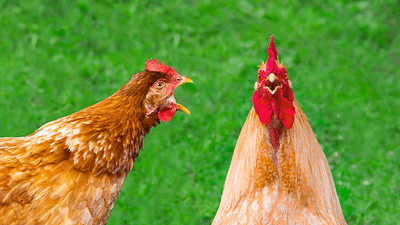


Aside from the inside of a goose's mouth, there's little poultry-based horror more terrifying than the idea of a chicken with teeth. That might be a sight which doesn't crop up very often, but thanks to the dreams of one Scottish surgeon working in the 1700s, it isn't completely unprecedented.
In modern times, dentists use titanium alloys for tooth transplants. As well as being durable and non-toxic – a quality you want from anything that is going to be occupying your mouth – one of the advantages of titanium is that it's particularly good for bones to fuse to.
"One of the key aspects to dental implant success is a process known as osseointegration. The idea being that when the titanium implant is secured into the jawbone the surrounding bone tissue merges and fuses with it over time," Sheen Dental explains.
"This creates a super strong platform that becomes a base for a single crown, a dental bridge, and even part of a framework for an entire row of implant retained dentures."
In earlier times, we didn't have this option. The earliest evidence we have of a tooth transplant comes from around 600 CE. Excavating ancient Maya sites, archaeologists have found teeth replaced with objects such as seashells and pieces of jade. But humans have been experimenting with transplantation for a long time,
"It’s hard to say when tooth transplants first occurred. But transplants in general are one of the world’s oldest forms of surgery and come to us from horticulture," Dr Paul Craddock, a cultural historian and author of the book Spare Parts: An Unexpected History of Transplant Surgery, explained to IFLScience.
"They’re so old, they’re almost primal. Bottom line is that binding living things to one another so they grow together as one body has been a part of surgery for as long as anyone can remember. At least as far back as the sixth century [BCE] in the form of skin grafts, but almost certainly much earlier."
Dr John Hunter, who lived from 1728 to 1793, was an advocate for the transplantation of teeth, from one person to another. He also made a huge mistake about syphilis and gonorrhea, but we should probably ignore that for now as we've got chicken teeth to talk about.
While the 1752 Murder Act permitted the use of executed murderers for the purpose of medical study and teaching, there weren't nearly enough corpses to go around. Hunter regularly worked with "resurrectionists", or, as we now call them today, graverobbers, and learned as much as he could about the anatomy of the mouth and jaw, becoming convinced that human-to-human transplants were the way forward for dealing with missing teeth.
"Dr. Hunter suggested transplanting teeth from one human to another; his experiment involved the implantation of an incompletely developed tooth into the comb of a rooster," a paper on the topic explains. "He observed an extraordinary and astonishing event: the tooth became firmly embedded in the comb of the rooster and the blood vessels of the rooster grew straight into the pulp of the tooth."
This was Hunter's only foray into xenotransplantation, or transplanting human parts into an animal, but it was not his only time mixing things around in chickens. In fact, the "successful" tooth experiment was only after several other failures. In other experiments, he transferred a cockerel's spur onto a separate cockerel, and placed the testicles of one rooster into a hen's abdomen.
Nor was it the first time that teeth had been transferred between human and animal, with a 1685 dental text recommending the use of teeth from sheep, goats, dogs, and baboons, as long as the tooth was right size and shape for the job.
While Hunter was a respected surgeon, perhaps a little too respected given the aforementioned syphilis and gonorrhea debacle, it isn't clear that the tooth really fused to the rooster and it may have merely been jammed in there quite nicely, as with tooth transplants in humans.
Tooth transplants did briefly take off in the 18th century, but it wasn't without issues in tow. The ethical problem was pretty grim, with teeth being taken from healthy (but poor) humans and given to rich patients who could purchase them, as well as from young and healthy (well, not entirely health) cadavers when the law allowed it. The problem of infection was an issue too, including the spread of syphilis.
It also wasn't that effective. Dentist Ollie Jupes explained to IFLScience that the issue is finding the right-shaped tooth for the hole. While that is easy enough with modern day implants, which are etched a bit like a screw for the bone tissue to fuse to, doing the same with human teeth is not so easy nor effective.
“You might get a few months, or at most a few years, out of a tooth, but you’d invariably need another when that fell out (and if there was no compatibility between donor and recipient it wouldn’t take at all),” Craddock added.
Sometimes, when someone loses a tooth today it can be placed back in, but the blood vessels do not usually survive, requiring a root canal later on to prevent infection. Generally, modern dentists also avoid placing teeth into live poultry.