Nature
 PUBLISHED




In a new paper, a team of moss scientists have explained how they provided key evidence in an unusual graverobbing case in Alsip, Illinois.
Matt von Konrat, lead author on the paper, is a bit of a fan of detective shows. As a scientist who primarily studies moss, you might not expect too much opportunity to get involved in real-life investigation. But in 2009, investigators reached out for his team's help.
"I answered the phone, and it was the FBI, asking if I could help them identify some plants," von Konrat explained in a statement.
The FBI was investigating alleged crimes at the historic Burr Oak Cemetery, a 60-hectare (150-acre) graveyard in Alsip, in the suburbs of Chicago. The cemetery, as well as being the final resting place for thousands of people in the area, is home to the grave of Emmett Till, whose murder was a catalyst for the civil rights movement at the time.
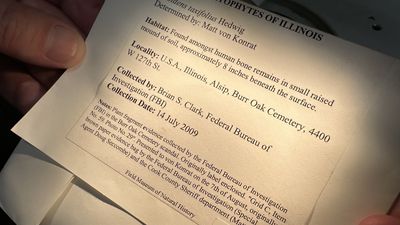
The FBI suspected four workers of disinterring human remains, as well as their caskets, before reselling the now-empty burial plots, and moving the previous occupants to an unused area of the cemetery. Overall, the FBI found around 1,500 bones belonging to at least 29 people. Investigators found a piece of moss, buried beneath the soil, and wanted the team to weigh in on what type of moss it was and, if possible, how long it had been buried there.
"We did a survey of the different kinds of mosses growing near the crime scene, and that species of moss was not growing there," von Konrat explained, adding that they determined it to be Fissidens taxifolius, or common pocket moss. "But when I surveyed the rest of the cemetery, we found a huge colony of that species of moss growing in the same area where the investigator suspected the bones had been dug up from. So that gave us pretty strong evidence that the remains had come from this other section of the cemetery."
While that was useful, what the FBI really wanted was a timeframe on when the moss was buried. The moss was buried with what they suspected were reburied remains, and knowing when the moss was interred could provide investigators with evidence on when the bodies were buried, too. Moss, it turns out, is not a criminal's friend on this front.
"Moss is a little bit freaky," von Konrat explained. "Mosses have an interesting physiology, where even if they're dry and dead and preserved, they can still have an active metabolism, a few cells that are still active. The amount of metabolic activity deteriorates over time, and that can tell us how long ago a moss sample was collected."
When the case came to trial in 2015, the suspects claimed that the remains had been reburied prior to their employment at the cemetery. But the moss told a different story. The team measured the amount of light absorbed by the chlorophyll within moss of various ages, comparing it to fresh specimens as well as the moss found buried at the crime scene.
As well as this, the team rehydrated specimens of different ages, finding that the buried moss rehydrated and began weak regrowth, which would be expected if the moss was dead, but with some cells still alive. Overall, they concluded that the moss must have been buried only a year or two before it was discovered.
"The combined analyses and observations in this study strongly indicated that Item No. 59 was a live plant when buried," the team explains in their paper. "It was likely exposed to no more than three seasons (spring/summer/fall) within a single year, predicated on the fact that the moss retained its green coloration, was shielded from sunlight within a soil mound above ground surface, and was saturated with infiltrating rainwater during the months of high precipitation. These facts supported the assertion that Item No. 59 had been deposited after the winter of 2007 – during the employment of the suspects."
The use of moss in criminal investigations is pretty rare, and according to the team, this is the first time moss has been used to establish a timeline in a court in Illinois.
"Every once in a while, a case comes along where the FBI has to call in experts to aid in the collection of evidence, do analyses, present the evidence to the prosecutors, and testify about their work if necessary to secure a conviction,” Doug Seccombe, a former FBI agent who worked on the case and the paper, added. "The Burr Oak Cemetery case was one of those cases where we reached out to the Chicago Field Museum Botanical Program, which proved to be extremely invaluable because plant material inside the cemetery was key to charging four individuals and securing their convictions."
In a separate 2025 paper, von Konrat and other authors found that there were only around a dozen cases where mosses and other bryophyte plants were used as forensic evidence over the past hundred years.
"Mosses are often overlooked, and we hope that our research will help raise awareness that there are other plant groups out there, apart from flowering plants, and that these serve a very important role in society and around us," von Konrat added. "But most importantly, we want to highlight this microscopic group of plants as a tool for law enforcement. If we can elevate mosses as potential evidence, maybe it could help some families somewhere in the future."
In 2015, the defendants were convicted of desecrating human remains, in part thanks to moss science.
The study is published in Forensic Sciences Research.