Nature
 PUBLISHED
 1
1



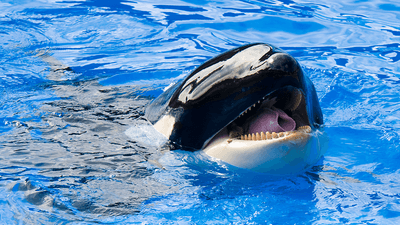


In 2018, scientists recorded the first known instance of an orca imitating the noises of a human, including, but not limited to, fart sounds.
Whale language, it turns out, is pretty complex. Studying the language of sperm whales, the Cetacean Translation Initiative (CETI) recently found that they not only produce vowels but also diphthongs, a language feature thought previously to be unique to humans.
"This discovery opens an entirely new chapter in our understanding of sperm whale communication,” David Gruber, Founder and President of Project CETI, said in a statement emailed to IFLScience. “By integrating linguistics and non-human communication, we are now aware that sperm whales have vowel- and diphthong-like structures in their voices, and that they evolved an entirely independent way of producing vowels.”
CETI aims, ultimately, to understand as much as it possibly can about whale communication and "eventually talk back." That's all well and good, but what effort are the whales putting in? Have any of them even tried to speak a little human?
It turns out yes. In 2018, a study documented the time two killer whales were trained to imitate and produce certain sounds, including several words, spoken by their trainer. While the result is a whale saying words like "hello," "bye bye," "one, two, three," and "ah ha," the research was motivated by the observation of vocal mimicry in other animal species, a large factor in spoken communication and so important to human culture.
"Comparative evidence has revealed that although the ability to copy sounds from conspecifics is mostly uniquely human among primates, a few distantly related taxa of birds and mammals have also independently evolved this capacity," the team writes in their paper. "Remarkably, field observations of killer whales have documented the existence of group-differentiated vocal dialects that are often referred to as traditions or cultures and are hypothesized to be acquired non-genetically."
The first part of the experiment saw researchers from the Animal and Human Behavior Study Group (GECAH) at the Complutense University of Madrid training 3-year-old male orca Moana to produce five distinct new vocalizations on command, selected for being as distinct as possible from its natural vocalizations.
The main part of the experiment saw another orca, 14-year-old female Wikie, attempt to reproduce these sounds from Moana, doing so with ease whether they were produced by Moana directly or played through a speaker. But perhaps the more impressive part came when the team began experimenting with more varied vocalizations and sounds, including six different human sounds and phrases, creaking doors and elephant sounds, and a hefty raspberry/fart noise.
While it is impressive that the whales were able to reproduce these sounds, don't expect them to be staffing call centers any time soon or putting on an all-whale production of Moby Dick. But the team did test the sounds produced, comparing their waveforms with the original source sounds and playing the noises to six judges, who were asked to assess whether these and other orca sounds matched the original source.
"Although the subject did not make perfect copies of all novel conspecific and human sounds, they were recognizable copies as assessed by both external independent blind observers and the acoustic analysis," the team explained in their paper, adding "this accuracy level is particularly remarkable given that the subject possessed a very different sound production system compared to humans."
It is, of course, important to remember that this isn't whales talking with humans, nor humans talking with whales. There is no suggestion that the whales understood what they were mimicking at all, even if they parroted (killer whaled?) it back beautifully and with vocal equipment far different from our own.
"With regard to the issue of how it is copied," the team adds, "our data might indicate that the sensory–perceptual and cognitive skills recruited in imitating in-air sounds are ancestral traits, dating back to the terrestrial ancestors of cetaceans."