Health and Medicine
 PUBLISHED




In 1984, a woman who was in otherwise perfect health started hearing voices. Understandably, the experience made her fear for her mental wellbeing, and she sought out the help of a psychiatric specialist. That specialist was consultant psychiatrist Ikechukwu Obialo Azuonye, who later published the incredible tale of what came next in a 1997 issue of the BMJ.
Early messages from the voices were oddly specific. “Please don’t be afraid,” they told her. “I know it must be shocking for you to hear me speaking to you like this, but this is the easiest way I could think of. My friend and I used to work at the Children’s Hospital, Great Ormond Street, and we would like to help you.”
She was given an initial diagnosis of functional hallucinatory psychosis and offered counseling and a prescription for thioridazine – an antipsychotic used in the treatment of schizophrenia, among other conditions. The voices disappeared, and the patient was able to go on holiday.
The relief was short-lived, however. While abroad, the voices told her to return to England promptly so that she could get treatment for something that was wrong with her.
The voices also provided her with an address. By this time, she had started to believe what they were telling her, as they had been correct about some details of her life in the past. To reassure her, the patient’s husband drove her to the address, where they found the computerized tomography (CT) department of a large London hospital.
The voices told her that she should go inside because she had two things wrong with her: a brain tumor and inflammation of the brain stem. The patient was greatly distressed, and so Azuonye requested a brain scan for further reassurance.
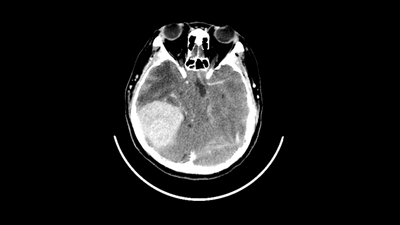
After some resistance, the request was granted, and the scan revealed a mass consistent with a large meningioma. Despite an apparent lack of symptoms such as headache or visual disturbance, it was suggested that surgery was the best course of action, and the tumor was removed.
Following the surgery, the patient heard just one last message from the voices. “We are pleased to have helped you. Goodbye.”
Azuonye writes that he was prompted to publish the case study after receiving a telephone call from the patient to wish him a merry Christmas, 12 years after her surgery. In it, he reflects on the unique circumstances surrounding her case.
“It is well known that intracranial lesions can be associated with psychiatric symptomatology. But this is the first and only instance I have come across in which hallucinatory voices sought to reassure the patient of their genuine interest in her welfare, offered her a specific diagnosis (there were no clinical signs that would have alerted anyone to the tumour), directed her to the type of hospital best equipped to deal with her problem, expressed pleasure that she had at last received the treatment they desired for her, bid her farewell, and thereafter disappeared.”
Of the more grounded explanations is the possibility that the patient was subconsciously aware of the tumor, which at such a size would typically be expected to cause at least some discomfort. The voices may have been a hallucinatory presentation of her own concerns – concerns that went away when the tumor was removed, and the voices said goodbye.
An eerie tale and poignant reminder that sometimes life really is stranger than fiction. In fact, all kinds of strange neurological conditions have inspired science fiction – just look at the case of the woman who saw dragons instead of faces.