


 Humans
 PUBLISHED


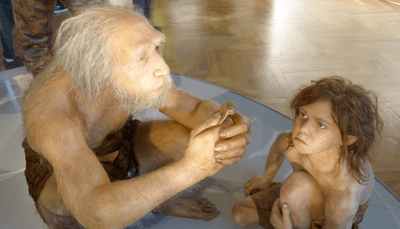


On June 11, 1926, archaeologist Dorothy Garrod discovered five Neanderthal skull fragments in the spookily named Devil’s Tower rock shelter, nestled in the north face of the Rock of Gibraltar. Belonging to a male Neanderthal child who died at three years of age, the fossils have kept researchers on their toes for a century, providing unprecedented insights into the secrets of our extinct cousins while also raising a number of unexpected new questions.
Frustratingly, experts are still unsure of the specimen’s age, with estimates ranging from 30,000 to 130,000 years. However, in 2019, researchers came up with some unexpected findings when examining traces of ancient DNA extracted from the petrous bones of both the Devil’s Tower Neanderthal and a separate individual that was found a stone’s throw away in Forbes’ Quarry.
In a superb case of nominative determinism, this skull was unearthed by a British military lieutenant named Edmund Flint in 1848. Known as Gibraltar 1, this specimen yielded a higher concentration of intact DNA than the child, which is labeled Gibraltar 2.
A mysterious age
Given that the southern tip of the Iberian peninsula is considered to have provided the final refuge for Neanderthals during the Ice Age, some scholars had expected a relatively young age for the two individuals from Gibraltar. This theory was supported by the discovery of late Neanderthals at various sites across Spain, including the 49,000-year-old skeletons from the famous El Sidrón Cave.
Surprisingly, however, Gibraltar 1 turned out to be more closely related to 120,000-year-old Neanderthals from Belgium and Germany than to the El Sidrón group. And while we don’t know if the same is true of Gibraltar 2, this unforeseen finding suggests that the Neanderthals that occupied the Rock of Gibraltar may have represented a much earlier population than those found elsewhere in Iberia.
A carnivore diet
As for the child, not much more is known, although analyses of the teeth and skull bones have helped to provide some general information about Neanderthals. For example, the developmental state of the dentition has been found to roughly match that of a three-year-old human hunter-gatherer, yet the cranial fragments indicate a much larger brain. This fits with existing models regarding the rapid cerebral expansion of Neanderthal infants and toddlers.
Furthermore, an analysis of the striations on the youngster’s teeth has been found to roughly match those seen in Eskimos and Indigenous hunter-gatherers from southern Patagonia, both of which typically consume highly carnivorous diets. This, again, hints at key differences between the Gibraltar Neanderthals and those from El Sidrón, which are thought to have enjoyed a more varied plant-based diet including pine nuts, moss and mushrooms.
After a century of study and debate, then, it seems the more we learn about the Devil’s Tower Neanderthal child, the more we realize we don’t really know about this prehistoric hominin.


 1
1