Nature
 PUBLISHED


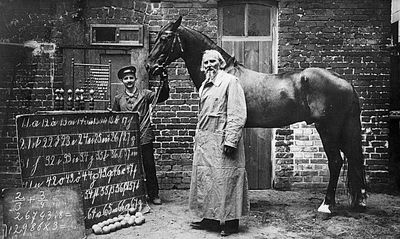


For a brief time in the early 1900s, scientists believed that a horse could read German, recognize painters by their style, and do complex maths.
Sometimes knowledge is a curse. Today, we know that if you want somebody to distinguish between a composition by Chopin and Tchaikovsky, you're probably better off going to someone with some musical training than a horse. Back at the beginning of the 20th century, it apparently could be either-or.
Are horses smart?
In 1900, mathematics teacher Wilhelm von Osten grew tired of working exclusively with humans – or found the challenge beneath him – and took it upon himself to train a horse to do sums. For four years he put the horse through advanced horse math class, before presenting the results to the world. The horse would respond to questions from his trainer using hoof taps, the horse having skipped all classes on enunciation. For instance, when asked to perform sums, the horse would clop out the correct number required of him shortly afterward.
This of course required the horse to know German, a language in which it appeared that Hans could also spell. Using his hooves to tap out letters of the alphabet (A=1, B=2, etc) the horse apparently could spell out the names of people and communicate in full sentences. With no classical art training, he could also identify artists by their works.
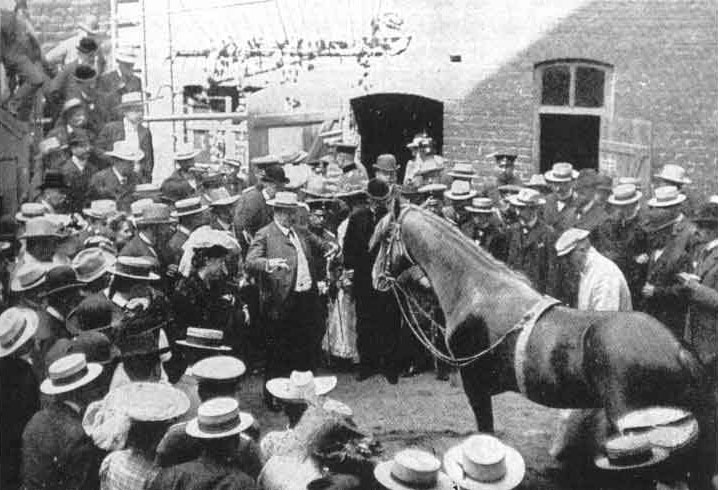
Needless to say, the horse was a hit on par with The Beatles (in the world of horse math, anyhow) and large crowds came to watch a horse communicate through tap. It wasn't just laypeople that were taken in, but scientists and biologists too.
There were, of course, neigh-sayers. As people had been riding around on them for centuries, it must have been quite disconcerting to suddenly be told that you'd been riding around on the back of something with the intelligence of an accountant, and some were naturally skeptical.
The first to try and rigorously test the horse was the German board of education in 1904, setting up a commission to find out what was going on. Over the course of a year and a half, the trials saw Hans's trainer separated from the horse to try and rule out any trickery. Despite this, the horse continued to be able to perform on demand, getting the answers correct nearly as often as when its own trainer was in the vicinity. The commission eventually concluded that there was no trickery involved, which was correct – but only on the human side of things.
Clever Hans effect
The commission then involved psychologist and biologist Oskar Pfungst, who managed to design much better experiments to test whether the horse really was communicating complex thoughts to those around him, and could understand complex language.
For a start, the experiments involved keeping the questioner away from the horse, so that it could not pick up clues from their expressions (voluntary or involuntary). In another test, the questioners did not know the answers to the questions they were posing. Through these methods, he was able to determine that when the questioner did not know the answer, neither did the horse, and when the horse could not see the questioner or any other spectators it performed about as well as, well, any other horse.
Pfungst figured out that Hans was not a genius math horse who had merely put the hours in, but was reading the facial cues and posture of those around him who knew the answers. When the horse had tapped out the correct number, an audience or questioner would react (sometimes without noticing it themselves), giving the horse the clue that it was time to stop tapping, in order to receive his sugar cube.
Hans may not have learned mathematics from us, but we sure learned a lot from him – mainly about experimental design, and taking extra precautions against subjects (animal or human) being able to read cues from their experimenters.
While still pretty neat, Hans soon lost his following when it turned out he was merely extremely good at reading the emotional responses of humans, rather than adding. He ended up being roped into World War I and was either shot or eaten by troops. What a life.
An earlier version of this story was published in July 2021.