Nature
 PUBLISHED


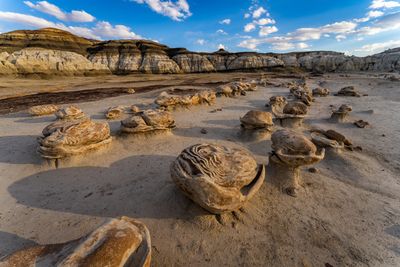


The Bisti Badlands (“Bisti” meaning "a large area of shale hills” in the Navajo language), also known as the De-Na-Zin Wilderness (from the Navajo words for "cranes”), has been shaped by millions of years of weathering and erosion. Back in the Cretaceous Period, it was covered by the Western Interior Seaway, but then a volcano coated the area in ash and the sea began to recede.
It created an expanse of wetlands and riverbeds that were home to ancient animals like dinosaurs and reptiles. One such creature was the “Bisti Beast”, a tyrannosaur whose skull is now on display at the New Mexico Museum of Natural History and Science in Albuquerque.
It was declared a new-to-science species in 2010, getting the fancy scientific name Bistahieversor sealeyi. Named for the Bisti Wilderness Area and the Greek for “destroyer” (eversor), the second part is a hat-tip to Mr Paul Sealey, a research associate at the museum who discovered the holotype.
The ancient wildlife that’s been found here is pretty cool, and the same is true when it comes to animals still alive today. Golden eagles, towhees, and ravens swoop around the sky in search of cottontails. You’ll also be sharing the land with coyotes, and may get a visit from Scolopendra heros, also known as the giant desert centipede. “Giant” seems about right, considering they can grow up to 20 centimeters (~8 inches).
When the water receded, it left behind layers of sandstone, mudstone, shale, and other sedimentary rock – and then when the last Ice Age ended, the landscape really started to get weird as waters from melting glaciers carved paths through the rock. The once-smooth landscape was shaped into channel deposits by water and wind, which is why one region of the Bisti Badlands has the nickname “Alien Egg Hatchery”.
Regrettably, these are no alien eggs. The towering rock formations topped with psychedelic ovals are what’s known as hoodoos, rocky features formed by erosion. Hoodoos can form anything from tall spiny sticks to “goblins” – as seen at Bryce Canyon – and in the case of the Bisti Badlands, can resemble alien eggs.
These remarkable hoodoos make for dramatic photos when the sun is rising and as it sets, but conditions here can be testing. The best times to visit are between March to May and September to November when temperatures are mild, as winters can dip below freezing and the summer sees highs of 38°C (100°F).
The Bisti Badlands are proud to be a wilderness area and have been largely left alone, with no marked trails, facilities, or visitor centers. As such, it’s a place for great adventures, but might not be suitable terrain for everybody. Check out the Bureau Of Land Management’s website for more advice about exploring the Bisti Badlands.
How to get there: You’ll find the egg-like hoodoos about a mile’s hike from either of the two access points to the Bisti Badlands, 58 kilometers (36 miles) south of Farmington, New Mexico.
This feature first appeared in Issue 33 of our digital magazine CURIOUS. Older issues of CURIOUS are free for all users. To access new issues, become an All Access Member.