Nature
 PUBLISHED


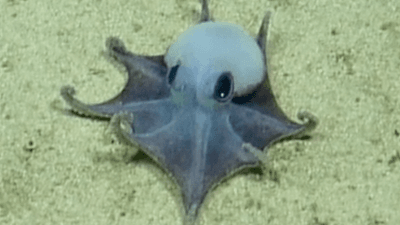


If you go down into the deep blue sea today, you never know what you might uncover. Vast areas of the ocean are still unexplored and understudied and, as a team looking in the waters of the Galápagos Islands off the coast of Ecuador discovered, home to a tiny new species of blue octopus.
A 10-day expedition aboard the E/V Nautilus was exploring the Galápagos Marine Reserve in 2015. Using a ROV around a seamount near Isla Darwin, the team discovered a tiny blue octopus at 1,773 meters (5,816 feet) deep.
I was sent a bunch of photos of cephalopods to try to identify and suddenly this octopod was there! I was like WHAT?
Dr Janet Voight
The team’s obvious delight can be heard on the video recording of the encounter as they exclaim, “It's blue!”
The scientists managed to collect a female specimen of the octopus and video record two more of what looked to be the same species, before bringing the sample to the surface to be photographed and preserved for further scientific investigations – along with plenty of other samples from the expedition.
Enter octopus expert Dr Janet Voight, who was contacted and emailed a photograph of the species.
“I was sent a bunch of photos of cephalopods to try to identify and suddenly this octopod was there! I was like WHAT?,” Voight, lead author of a study on the new species and Curator Emerita at the Field Museum in Chicago, told IFLScience.
“Its shape is like that of a genus of octopods known from Antarctica and as far north [as] Uruguay, its color totally different. I wanted to see the specimen!”
Getting the specimen to Voight, however, was no small challenge: “getting the specimen legally exported from the National Park in the Galápagos and sent to me in Chicago. There are a myriad of safeguards in place to protect the endemic biodiversity; I could only sit in Chicago and hope things were moving ahead.”
People don’t realize that just the Pacific Ocean covers more of the planet’s surface than all the land areas combined. And every bit of the ocean, a three-dimensional habitat, supports animal life.
Dr Janet Voight
Once the tiny, golf ball-sized octopus had arrived, challenges still presented themselves in terms of fully understanding and being able to describe a new species.
“I felt we had to use CT because it is a unique specimen that is nearly impossible to duplicate. I didn’t have enough confidence in my ability to make the required dissections and feared that I would be cutting through structures that would later prove to be important,” explained Voight.
With help from Stephanie Smith, the manager of the Field Museum’s X-ray computed tomography laboratory, Voight was able to create micro CT scans of the octopus, revealing fine details of the structures and organs within the specimen.
“What really struck me was that the scan of the little octopus revealed so much information on its internal organ systems – usually, soft-part imaging using micro CT requires the use of heavy-metal-based contrast agents whose use would not be desirable with such a rare specimen. This made the 3D modeling of relevant organs really an easy task,” said Alexander Ziegler, a researcher at the University of Bonn in Germany and senior author of the paper, in a statement.
The new species has been named Microeledone galapagensis after the islands where it was discovered, and is described as squat with slightly protruding eyes.
“People don’t realize that just the Pacific Ocean covers more of the planet’s surface than all the land areas combined. And every bit of the ocean, a three-dimensional habitat, supports animal life. This is the second known specimen in a genus that was erected for a specimen from New Caledonia; you have to ask, what else is out there?” said Voight.
The study is published in Zootaxa.