Nature
 PUBLISHED


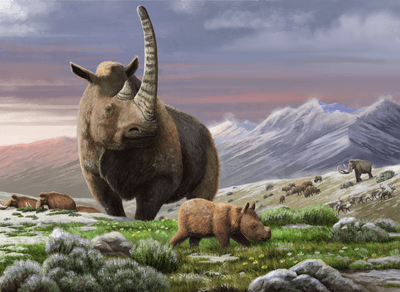


The woolly rhinoceros seems at home in the Ice Age tundras of Eurasia, but it looks like this wasn’t where these shaggy, horned beasts thrived. Further south, the species had a much more robust gene pool, thanks in part to a spot of inter-species hybridization.
In a new study, scientists led by Peking University in Beijing extracted ancient DNA from 183 rhino fossils found across Europe, North Asia, Central Asia, and East Asia to better understand the lives of woolly rhinos, a cousin of today's rhinoceroses that fell into extinction around 11,000 to 14,000 years ago towards the end of the last Ice Age.
Their research successfully recovered 29 mitochondrial genomes and 14 whole genomes, providing the team with a broad view of their genetic diversity. The genetic data was paired with a climate model that pictured their habitat across Eurasia throughout the past 500,000 years.
This showed that the most significant split between all modern woolly rhino lineages occurred around 460,000 years ago, with a clear genetic divide between East and West Eurasia populations during a rocky transition between glacial and interglacial periods.
Surprisingly southern
Surprisingly, genetic diversity was strongest in the mid-latitude regions, slightly closer to the equator, not in the high Arctic.
The Altai region, the mountainous region where Siberia, Mongolia, China, and Kazakhstan meet, also appears to have acted as an important refuge amidst the climatic upheavals during their tenure.
"The Altai region may have functioned as a reservoir for genetic ancestry before the Late Pleistocene and as an important dispersal hub for woolly rhinoceroses across western and northern Eurasia, which is supported by the persistence of suitable habitats under varying climatic conditions," the authors write.
“Together, these findings suggest that East Asia was one of the sources of genetic diversity for Late Pleistocene woolly rhinoceroses across Eurasia."
That’s a big contrast with the woolly mammoth, whose genetic diversity is strongest in the high latitudes where cold and harsh conditions prevailed.
It’s even a divergence from what’s generally assumed about woolly rhinos. Much of the evidence about this species comes from northern Eurasia, but this may be skewing our picture of Ice Age megafauna simply because this is where genetic remains are best preserved.
“Although excellent DNA preservation in northern Eurasia has facilitated deep-time genetic studies, this preservation bias toward high-altitude regions may obscure the full scope of population structure and evolutionary history,” the authors conclude.
Interbreeding hybrids of the Ice Age
Another surprising tidbit of the study was the presence of Merck’s rhino DNA in the genome of woolly rhinos, indicating the two species must have interbred in their overlapping habitats.
Merck's rhinos are a large, extinct species that lived alongside their woolly relatives across Pleistocene Eurasia, but generally favored warmer, more forested habitats. Despite their differences, hybrids of the two were also part of the megafauna mix in Ice Age Eurasia.
“Cross-species gene flow among different extant and extinct lineages could have played an important role in the evolution of rhinoceros species,” the study notes.
Interbreeding isn't just a feature of rhinos from the distant past, either. In 1977, a northern white rhinoceros and a southern white rhinoceros bred to produce a single offspring at a zoo in Czechoslovakia. Named Nasi, the hybrid was the only confirmed, naturally born cross between the two subspecies on record.
Nasi passed away in 2007, but her case offers some hope for the northern white rhino, which has been reduced to just two individuals, both female.
If Nasi is anything to go by, southern white rhinos could serve as surrogates for their northern cousins as a last-ditch effort to save the seemingly doomed subspecies.
The new study is published in the journal Science.