Nature
 PUBLISHED



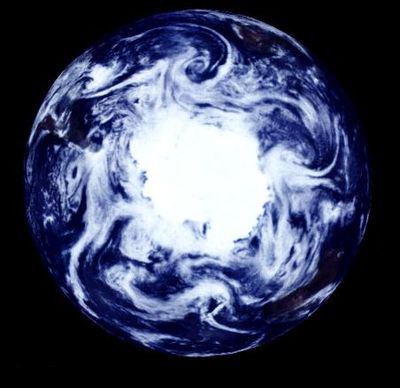


In 1985, scientists “accidentally” discovered a yawning hole in the ozone layer above Antarctica.
Initial research suggested the problem had emerged as recently as the late 1970s, but a new analysis from the Massachusetts Institute of Technology (MIT) suggests that human activity was starting to meddle with the ozone layer decades before that.
“The fact that ozone depletion would have happened as early as the late 1950s, which is much earlier than I would have thought, just absolutely blew my mind,” Professor Susan Solomon, an early pioneer in the study of ozone’s effects on the atmosphere, and the Lee and Geraldine Martin Professor of Environmental Studies and Chemistry at MIT, said in a statement.
The revelation came when the team investigated whether other chemicals may have been depleting the ozone layer long before chlorofluorocarbons (CFCs) arrived on the scene.
CFCs aren't the only problem
The Antarctic ozone hole is attributed to the release of chlorofluorocarbons, chemicals once-widely used in refrigerants, propellants, and solvents that, if released, drift up into the upper atmosphere. Once in the stratosphere, the gas is broken down by ultraviolet radiation from the Sun releasing chlorine atoms that catalyze the destruction of ozone molecules.
However, this latest research highlights the impact of another ozone-depleting chemical that was widely used long before CFCs: carbon tetrachloride.
“What we’ve learned from textbooks is that CFCs result in ozone depletion,” said Jian Guan, the study’s first author and a graduate student in MIT’s Department of Earth, Atmospheric, and Planetary Sciences
“It turns out there was another compound that caused ozone depletion much earlier than CFCs. This was a big surprise.”
To dig deeper into this idea, the team designed a "thought experiment" to investigate when human-induced ozone depletion could first have been detected if scientists over the past century had had access to today's tech and know-how.
They used 16 different models that mimicked the chemistry of the atmosphere over the last century, attempting to spot any unusual changes in the ozone layer that could be attributed to human activity rather than natural phenomena, such as volcanic eruptions or El Niño, which can also affect ozone levels.
Each model was expanded to account for industrial chemicals that came into production at different points over the past century.
What the new research found
Their analysis revealed that a signal appeared as early as 1957. The only reasonable culprit, they found, was carbon tetrachloride.
“That’s the only ozone-depleting substance that was increasing that early,” Solomon explained. “We started using carbon tetrachloride in the 1930s as a dry-cleaning agent, and as a degreasing solvent. We didn’t start using CFCs until quite a bit later.”
However, the signal appeared high above the tropics, rather than over Antarctica, where the infamous hole eventually emerged. This is because natural variation over the equator's atmosphere is smaller, making any freak anomalies “stick out” more and easier to detect.
Bear in mind this is slightly different from the issue of the Antarctic ozone hole, which formed because CFCs were building up to such an extent that, combined with Antarctica's uniquely cold and isolated winter atmosphere, they triggered an explosive seasonal collapse in ozone each spring.
Regardless, the new research suggests that human activity has been messing with the ozone layer for much longer than previously suggested.
The big phase out
The good news is that both carbon tetrachloride and CFCs have since been phased out, and as a result, the hole in the ozone layer has undergone a truly remarkable recovery.
Even so, the new research highlights that CFCs aren't the only ozone-depleting chemical we should worry about. Many such chemicals have been banned, but plenty more are emerging that could also pose a threat. For instance, early research suggests that satellite and rocket launches, which are becoming alarmingly common in recent years, may also have a negative impact on the ozone layer, both during launch and upon satellite reentry.
If the planet is to stay healthy, well-balanced, and suitable for its current inhabitants, we must remain vigilant about the chemicals we're pumping into the atmosphere.
“We’ve gone through a big effort to get rid of these chemicals,” Solomon says. “Don’t we have an obligation to keep monitoring to make sure the atmosphere responds the way we think it should?”
The new study is published in the journal Proceedings of the National Academy of Sciences.