Nature
 PUBLISHED


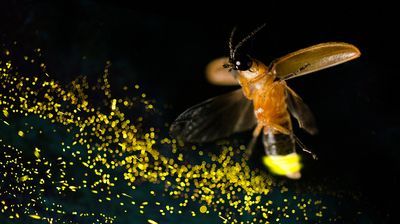


Attracting a mate, whether human or animal, comes with a certain level of courtship. While some people are impressed with fancy dinners or sunset beach walks, in the insect world, a firefly can win a partner with a well-controlled display of flashing butt lights, romantic hey? Now, researchers are taking a closer look at the genetics that lead to the development of flashing lights in fireflies.
The firefly (Aquatica leii) is an aquatic species in which both the males and females possess light organs capable of flashing signals to one another. The team looked closely at a male firefly's genome, which is the largest known among studied firefly species.
In these fireflies, while they are larvae, the light organ wards off predators and is formed on the eighth abdominal section. However, after the fireflies become adults, they have their light organs on a part of their abdomen that is arranged in sections known as the ventrites. In males, the light organ is on ventrites six and seven, while the females just have theirs on the sixth ventrite.
The team were partially interested in eight homeobox genes that control the positions of different cells during embryonic development. Some of these genes are also critical for the formation of the light organ in adult fireflies.
There were two important stages the researchers wanted to learn more about. The genes that control the position of the light organ within the abdomen of the firefly, and then those involved in the gene expression to generate the light within the organ itself.
This involves an enzyme called luciferase, which produces light when it oxidizes. First, the luciferase gene has to be expressed, meaning the insect is able to make that enzyme within its body. Second, luciferase has to be transported to the right place, in this case, it is the reaction organelle, to make the animal bioluminescent.
One transcription factor, AlABD-B, was found to be particularly important for the development of a typical light organ within the insects. AlABD-B also interacts with another homeobox transcription factor called AlUNC-4, which it helps regulate. Together they activate a gene called AlLuc1, which helps produce luciferase that makes the light organ bioluminescent. Three more genes ALAntp, AlRepo, and AlAp2 were found to be used in flash control of the light organ.
The team also found that luciferase interacts with peroxisomes and a lack of luciferase within these caused non-luminescence in the firefly, showing how important this enzyme is in creating a special firefly butt light display.
The paper is published in Nature Communications.