


 Nature
 PUBLISHED


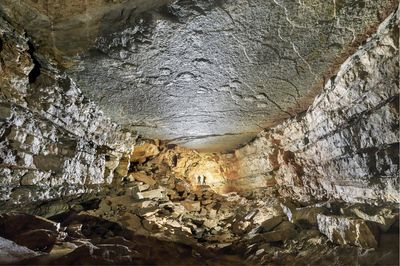


Fossil collectors will often have their heads buried in the ground, but in one peculiar cave in the south of France, palaeontologists have every reason to look up. Imprinted on the ceiling, like a prehistoric Sistine Chapel, you can find the footprints of colossal dinosaurs.
Nope, this doesn't mean that giant dinosaurs were dancing upside down on the ceilings of caves like a sticky-footed Spiderman, but it goes to show the wealth of prehistoric discoveries that could be found lurking in the geology all around us.
Palaeontologists from the University Burgundy–Franche-Comté discovered the three dinosaur trackways during an expedition in 2015 around the labyrinth-like Castelbouc Cave beneath the Causse Méjean plateau in southern France.
The tracks, formed some 166 million to 168 million years ago, are extremely well-preserved, complete with impressions of digits, pads, and even claws. At a stonking 1.25 meters (4 feet) long, the prints belonged to some of the largest known dinosaurs worldwide.
It’s not certain what species of sauropod was responsible for the tracks, not least because they date to an age in the Middle Jurassic when sauropod evolution is hazy. However, their size suggests they might have belonged to a titanosaur, a diverse group of long-necked sauropods that includes the largest land animals known to have ever existed, such as the 37-meter (121-foot) long Patagotitan that roamed southern Argentina.
So, how did these gentle giants' footprints end up on the cave roof? Back when sauropods were treading the Earth, the animals left their marks in soft sediment that slowly hardened into rock. Over millions of years, water carved out the cave system below, leaving that harder rock layer above, footprints and all, as the ceiling. With a bit of luck in how the sediment set, the impressions survive as embossed reliefs rather than being worn smooth.
Reaching this portion of the cave nowadays is not so easy. The tracks are found some 500 meters (1,640 feet) beneath Earth’s surface, only accessible after traversing a winding network of caverns that are often flooded with water after rainy spells. As the researchers note in the study detailing the discovery, finding dinosaur tracks in this kind of environment is extremely rare, but it suggests that the scarcely explored caves of the world could be home to much more prehistoric treasures than thought.
“This discovery demonstrates the great potential of prospecting in deep karst caves that can occasionally offer larger and better-preserved surfaces than outdoor outcrops,” the study authors write.
It wasn’t the first time dinosaur footprints in unusual circumstances have been discovered. Back in February 2020, researchers published another paper documenting a similar set of dinosaur tracks imprinted on the roof of a cave near Mount Morgan in Queensland, Australia.
An earlier version of this story was published in April 2020.



 1
1