Nature
 PUBLISHED
 8
8


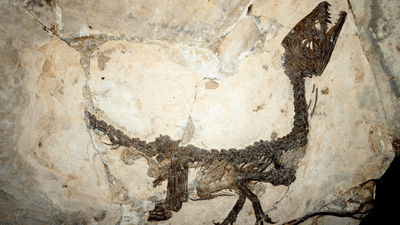


When you learn about fossils, you start seeing dates thrown about like “265 million years old” and “dating back to the Jurassic” like it's no big deal. Fossils can be incredibly, inconceivably old, but how do they survive so long while animal bones decay in just a few years?
It all comes down to the conditions in which an animal died, and what happened to their remains after they’d kicked the bucket. IFLScience got to see first-hand the fossilized bones of a giant sea monster that was chomping things in half 150 million years ago. As fossil expert Steve Etches MBE told IFLScience, part of the reason the pliosaur – an ancient marine reptile – was preserved so well was because it rolled in death, preserving its smile as it lay face-down in the mud.
“It’s good that it was upside-down because actually, this is the best side,” said Etches. “When you find a fossil in a ledge or whatever, we always turn them upside-down because when it dies, the bit that goes down in the mud is undisturbed. It’s always the top side that starts to degrade more rapidly."
Soft tissues typically decompose fairly quickly, though we do find rare examples of preserved bits of skin (even if some of them turn out to be forgeries). As for what keeps those bones seemingly so intact for millions of years, it all comes down to fossilization.
What is fossilization?
Fossilization can take many forms, but the best fossils are typically formed when the animal is quickly encased in sediment – like our upside-down giant sea monster – which can be in the form of mud or volcanic ash. As this sediment builds up it becomes lithified, meaning it turns to rock, locking the animal in place.
Permineralization is the most common type of fossilization that happens when water from the ground, lakes, or ocean carries minerals into organic tissues. Eventually, enough deposits are built up to create a kind of internal cast, which can be made of calcite, iron, or – as in the case of this staggeringly beautiful opalized plesiosaur – silica.
The minerals replace the organic materials within the bone, like collagen and other proteins, until the fossil contains more mineral crystals than the original bone. Those chalky ammonites you find along the fossil hunter's haven that is the Jurassic Coast have been filled in with calcite, while the astonishing fool’s gold examples are made up of pyrite.

If you want a fun way to demonstrate how minerals can create an internal cast to keen young scientists, the National Park Service has a great exercise you can try creating internal casts of sponges using salt water.
Are all fossils bones?
No. A fossil can be any trace or remains of past life, be that a footprint, burrow, a bit of skin, or a bone. As the Australian Museum explains, the word fossil is taken from the Latin word fossilis, which just means “dug up", it's not specific to bone.
Do animal bones decay?
A little something called the decomposition ecosystem makes quick work of animal remains exposed to the elements, something Dr Devin Finaughty told IFLScience all about during his talk at CURIOUS Live in 2023. “Decomposition is technically defined as the consumption of organic material by other organisms, [and is] distinct from physical degradation of organic remains by physical, erosive forces, like water. The decomposition ecosystem pivots around the dead body as a resource and that's mainly for food, but many organisms will also use it as a breeding ground as a nursery, and as a shelter.”
Once the decomposition ecosystem has had its fill, all that’s typically left behind is bone, and we can learn a surprising amount from skeletal remains that linger on longer than your typical corpse. They won’t remain forever, however, as even animal bone eventually decomposes. It can take several years, but the delicious collagen found in bones is a food source for bacteria and fungi that will eat away at it until the remains eventually crumble.
So, if you want to stick around as a fossil for the next few hundred million years, it’s time to write up very elaborate burial wishes.