Nature
 PUBLISHED


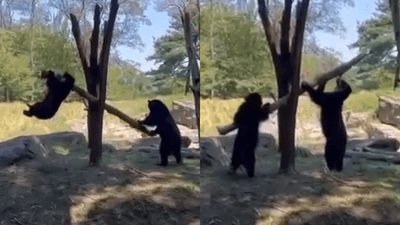


Here at IFLScience, we work hard to convince you that bears aren’t actually just a guy in a bear suit, but every so often, a video comes along that really doesn’t help our cause. The latest incident? Two young bears that appear to be playing seesaw with a tree branch.
The stars of the video are Andean bears Coya, a two-year-old female, and Ransisku, a three-year-old male, both resident at Queens Zoo, New York. They were filmed by visitor Ursula McDermott, who spotted them playing with a branch balanced in the gap of a tree, moving it up and down in a seesaw-like way. At one point, this sends Ransisku, seen on the left, amusingly launched upwards.
You might already be familiar with Andean bears thanks to the icon that is Paddington, and they even appear to share his love for a bit of marmalade. Like their fictional counterpart, they are indeed from Peru, and can also be found in the wild in Bolivia, Colombia, Ecuador, and Venezuela, though they’re rarely seen. In fact, Andean bears are the only bear species native to the entirety of South America.
One question that might be sparked from watching this video is whether or not these bears are attempting to use the branch as some sort of tool. They don’t appear to be trying to get to anything, like food, but it’s a reasonable thought; bears are typically considered highly intelligent, and there’s some evidence of limited tool use in brown, black, and polar bears.
However, when it comes to Andean bears in particular, evidence becomes even more scarce – not particularly surprising given their elusiveness in the wild. But it does exist.
In a 2020 blog post, the lead of San Diego Zoo Wildlife Alliance’s Andean bear conservation program, Dr Russell Van Horn, mentions a 1974 report about a young female bear at Zoo Basel using a stick to gain food, and he’s made similar observations himself.
“I have been fortunate to see tools being used by both of the adult Andean bears that now live in the San Diego Zoo. When I saw these bears in action, I had to stop and stare even though I frequently observe them,” he writes.
“Fortunately, I was able to use my phone to record videos of the male bear, Turbo, using a hard surface to try and access the marrow inside a beef bone, and the female bear, Alba, using a stick to try and dislodge some overhanging leaves. Although Alba stood on top of a wooden climbing structure when she swung her stick, she looked a lot like the 1974 photos from Zoo Basel!”
Whether or not you could successfully argue that what is seen in the recent video is potential tool use, it is considered normal behavior for the bears.
“As young bears, Coya and Ransisku are curious about everything in their environment,” said Mike Allen, Director of the Queens Zoo, in a statement. “While this particular interaction with the branch is unique and fun to watch, it’s very much in line with their natural instinct to explore, climb, and test their surroundings. They’re learning about their habitat – and each other – every day.”