


 Space and Physics
 PUBLISHED


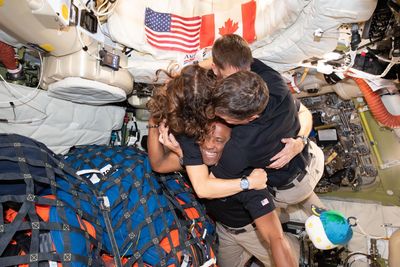


All good things come to an end. The Artemis II mission has been an incredible ride for NASA’s Reid Wiseman, Victor Glover, and Christina Koch and the Canadian Space Agency’s Jeremy Hansen. They are just a few hours away from coming back to Earth after having spent 10 days in space, going farther than any human has gone before. They could have broken a speed record too, but now, according to NASA, the capsule will not go as fast as the Apollo one.
The current record was set by the Apollo 10 mission, reaching 39,937 kilometers (24,816 miles) per hour during its re-entry back in 1969. The estimated re-entry speed for Artemis II now stands at 38,405 kilometers (23,864 miles) per hour.
At present, splashdown is expected at around 8:07 pm EDT on Friday, April 10, off the coast of San Diego. The USS John P. Murtha is already in position to go and pick up the astronauts, and the whole return will be livestreamed on NASA+, the agency's social media channels, and a variety of streaming platforms.
There is also some citizen science to be done if you are in Southern California. It is possible that as the spacecraft falls down to Earth (find out how in just a moment), it will generate a sonic boom. This happens when an object is moving faster than the speed of sound in that particular medium. The United States Geological Survey wants people to report in case they hear or feel the sonic boom from Artemis II.
About 42 minutes before splashdown, the Orion spacecraft will separate from the service module, around 20 minutes before getting to the upper atmosphere. During that time, Orion will get to its peak speed. The trajectory from 122 kilometers (400,000 feet) altitude to the Pacific Ocean will take 13 minutes.
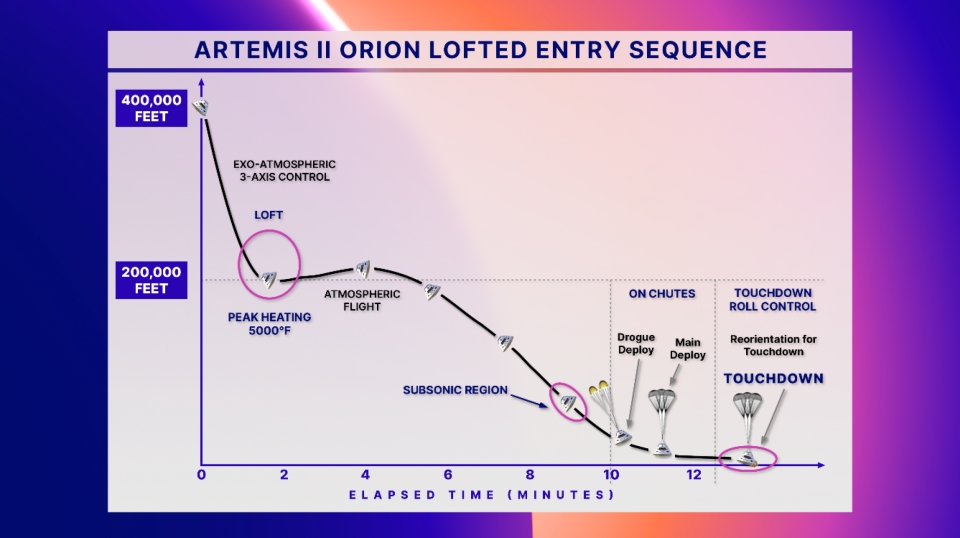
The capsule will experience peak heating between 122 and 61 kilometers (400,000 to 200,000 feet), where it will experience temperatures as high as half that of the Sun. During this time, there will be a six-minute communication blackout. The crew will experience accelerations of about 3.9 Gs (almost four times the gravitational pull from the ground). Rollercoasters can provide even higher Gs, but not sustained for so many minutes. The astronauts, though, have been trained for it.
They are expected to come out of the blackout at about 7:59 pm EDT and travel further down and further along. Only a few minutes before splashdown at 8:03 pm, when Orion is at 6.7 kilometers (22,000 feet) in altitude, the craft will release its drogue parachutes, and after about a minute and just 1.8 kilometers (6,000 feet) from the ground, its main parachutes will be deployed for a smooth splashdown.
Commander Weissman had previously hoped that eventually Artemis II would be forgotten, eclipsed by the expected future achievement of the Artemis program, but having seen this extraordinary adventure firsthand, we sincerely doubt that this will be the case.


 1
1