Space and Physics
 PUBLISHED



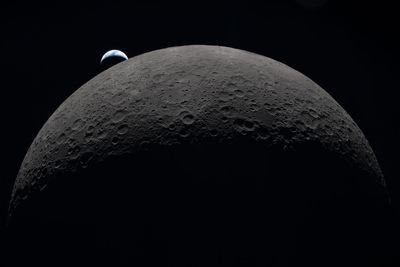


The Artemis II crew has now left the Moon behind and performed a correction burn to make sure they’re on the right trajectory to come back to Earth. The return is going to be a critical and delicate phase of the mission, as the astronauts will travel faster than any human has traveled before just as they encounter our planet’s atmosphere.
Last night, at 8:03 pm EDT, the Orion spacecraft, named Integrity, ignited its thrusters for 15 seconds. This produced a change in velocity of about 50 centimeters (1.6 feet) per second, and it has allowed the capsule to be on the correct path home. The re-entry is scheduled for Friday, April 10, 2026, around 8:07 pm EDT.
Integrity is planned to splash down in the Pacific Ocean off the coast of San Diego, California. The crew and capsule will be collected by the USS John P. Murtha, and NASA confirmed last night that the ship has left port and is now going to the midway point toward the recovery site. The exact timing and more precise locations will be available following more up-to-date weather forecasts.
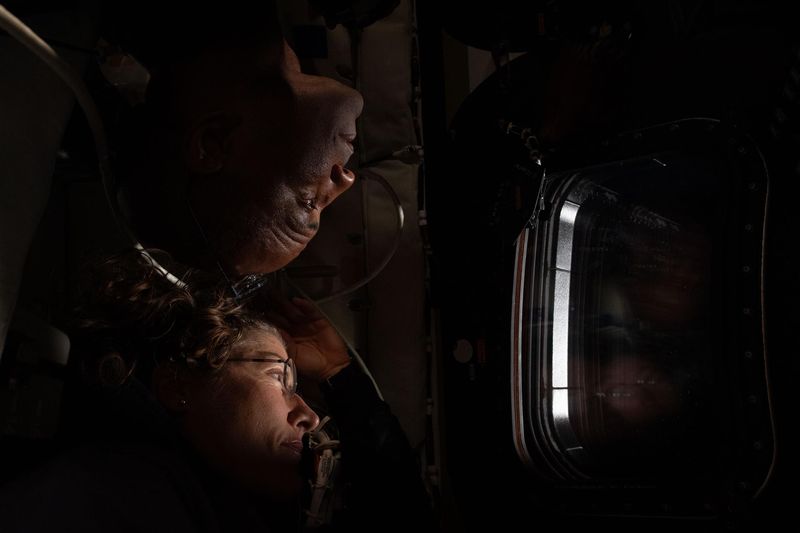
In space, the four members of the crew – NASA’s Reid Wiseman, Victor Glover, and Christina Koch, and Canadian Space Agency’s Jeremy Hansen – are falling toward our planet faster and faster as the gravitational pull of Earth becomes irresistible. They will reach the atmosphere traveling at about 40,000 kilometers (25,000 miles) per hour.
That could break the record set by Apollo 10 of 39,937 kilometers (24,816 miles) per hour for their re-entry. Artemis I, which was uncrewed, was just a hair slower than that, and it also used a slightly different path back down to Earth than Artemis II. Artemis I’s Orion used the skip re-entry approach, bouncing on the atmosphere to slow down a bit, before plunging in.
Re-entry involves using the atmosphere to brake before deploying parachutes. The heat shield is designed to withstand temperatures of many thousands of degrees, yet some unexpected cracks appeared in Artemis I. The skip re-entry approach is believed to have caused additional stress on the capsule heat shield. While a crew would have been safe onboard Artemis I, NASA decided to keep Artemis II’s crew safer by changing the re-entry method.
"NASA has modified the trajectory by shortening how far Orion can fly between when it enters Earth's atmosphere and splashes down in the Pacific Ocean," Kenna Pell, an Orion public affairs official at NASA's Johnson Space Center in Houston, told Space.com in February. "This will limit how long Orion spends in the temperature range in which the Artemis I heat shield phenomenon occurred."
More information about the re-entry will be available from NASA in the coming days.