Nature
 PUBLISHED


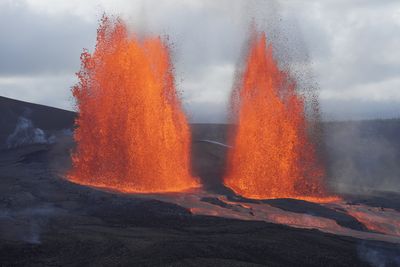


In its latest eruption event, Hawaii’s Kīlauea volcano sent a fountain of lava 540 meters (1,770 feet) up into the sky in what is a new record for this eruption, which began in December 2024. Some of the material it spewed out, known as tephra, was then transported by wind towards visitor outlooks and nearby communities.
Kīlauea is one of the world’s most active volcanoes, located on the southeastern side of the island of Hawai'i (the Big Island). It is an example of a shield volcano (because it looks like a shield lying on the ground), which means it has broad, gentle slopes that gradually rise to a dome peak. These slopes have been created by many consecutive eruptions that produce highly fluid, low-viscosity basaltic lava that flows down its sides.
The volcano forms part of Hawaiʻi’s Volcanoes National Park, which consists of Kīlauea and the much larger Mauna Loa. These volcanoes sit above a hotspot where plumes of hot mantle material rises towards the surface, melting the crust to produce magma.
Kīlauea has been experiencing episodic eruptions since December 23, 2024. These eruptions have mostly come from two vents – one in the north and one in the south – in Halema‘uma‘u, a pit crater within the volcano’s caldera. Generally speaking, these eruption events are not long, lasting less than 12 hours, and are often separated by long pauses that can last for two weeks.
In its latest eruption, known as episode 43, lava fountaining started on March 10 and lasted for only nine hours. But this was enough time to send considerable quantities of tephra into the air. This is a broad term for all fragments of all rocks – volcanic ash, pumice, scoria, Pele’s hair, and reticulite – ejected into the air by a volcano. In most cases, this debris falls directly onto the surrounding slopes, helping to enlarge them. However, billions of smaller or lighter particles can be carried on the winds for thousands of miles.
Most of the fallout accumulated at the Uēkahuna overlook and Kīlauea Military Camp in the Hawaiʻi Volcanoes National Park, as well as areas of Highway 11 and the Volcano Golf Course community. These areas are located to the northeast of the vents and experienced continuous ground coverage.
Lighter tephra was also reported across the surrounding area. There were over 200 tephra reports for this event.
Tephra fall can cause concern for nearby residents who are reliant on rooftop rainwater catchment systems, according to the United States Geological Survey (USGS). It can contain contaminants such as fluoride, arsenic, cadmium, chromium, copper, and lead. Although it initially gives the water a bad taste and makes it look dirty, subsequent rainfall can wash it off and transport it into the water system.
Residents using rainwater catchment systems are advised to disconnect their downspouts before tephra falls and to then clean it from their roofs and storage tanks before reconnecting them.
“These precautions are effective at minimizing impacts, and continued rainfall will naturally dilute any remaining contamination,” USGS said.
Tephra can also be an eye, skin, and respiratory irritant when exposed to it in the air. Those clearing it from their roofs are advised to wear protective equipment, such as masks, eye protection, and gloves.
Since episode 43 ended, there has been some inflation at the summit region, suggesting that episode 44 may soon follow. According to the USGS, models suggest this could occur between March 28 and April 14.