Nature
 PUBLISHED


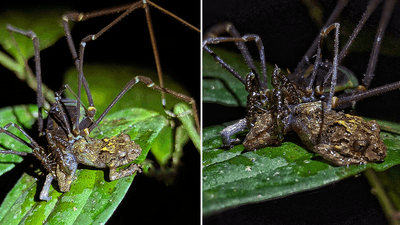


Typically, though not always, arachnids eat other invertebrates – spiders and small arthropods – as their prey. The role of arachnids as predators on vertebrates is not as well understood as their role on smaller prey, especially among the more gangly groups of arachnids like the harvestmen. However, reports from across the world have shown that far from limiting themselves to one kind of diet, the daddy long legs of the world are taking on the frogs.
While spiders represent a lot of the arachnids taking on vertebrate prey, the other taxonomic groups don't seem to be getting as much attention. Enter the Opiliones, also known as the harvestmen, which comprise around 6,700 species including some of those known as daddy long legs. While they lack venom, they have a wide range of behavioral tactics which they can use to capture and consume prey several times their own size.
In several observations in South America, researchers witnessed members of the harvestmen preying on frogs, even capturing and consuming them. On February 5, 2020, during a survey at a wildlife refuge in Ecuador, “a male Holocranaus aff. angulus [...] was observed preying on a live Pristimantis sp,” write the authors.
Two other similar observations were also recorded in Ecuador, all involving frogs being slowly consumed by different species of harvestmen on foliage above the ground.
“I didn’t know this was something special,” Lizardo Proaño, guide at Mashpi Lodge in Ecuador told Smithsonian Magazine. “I thought it was normal because frogs are good prey for everybody. They don’t have any scales or hard bones. They are like gummy bears in the forest.”
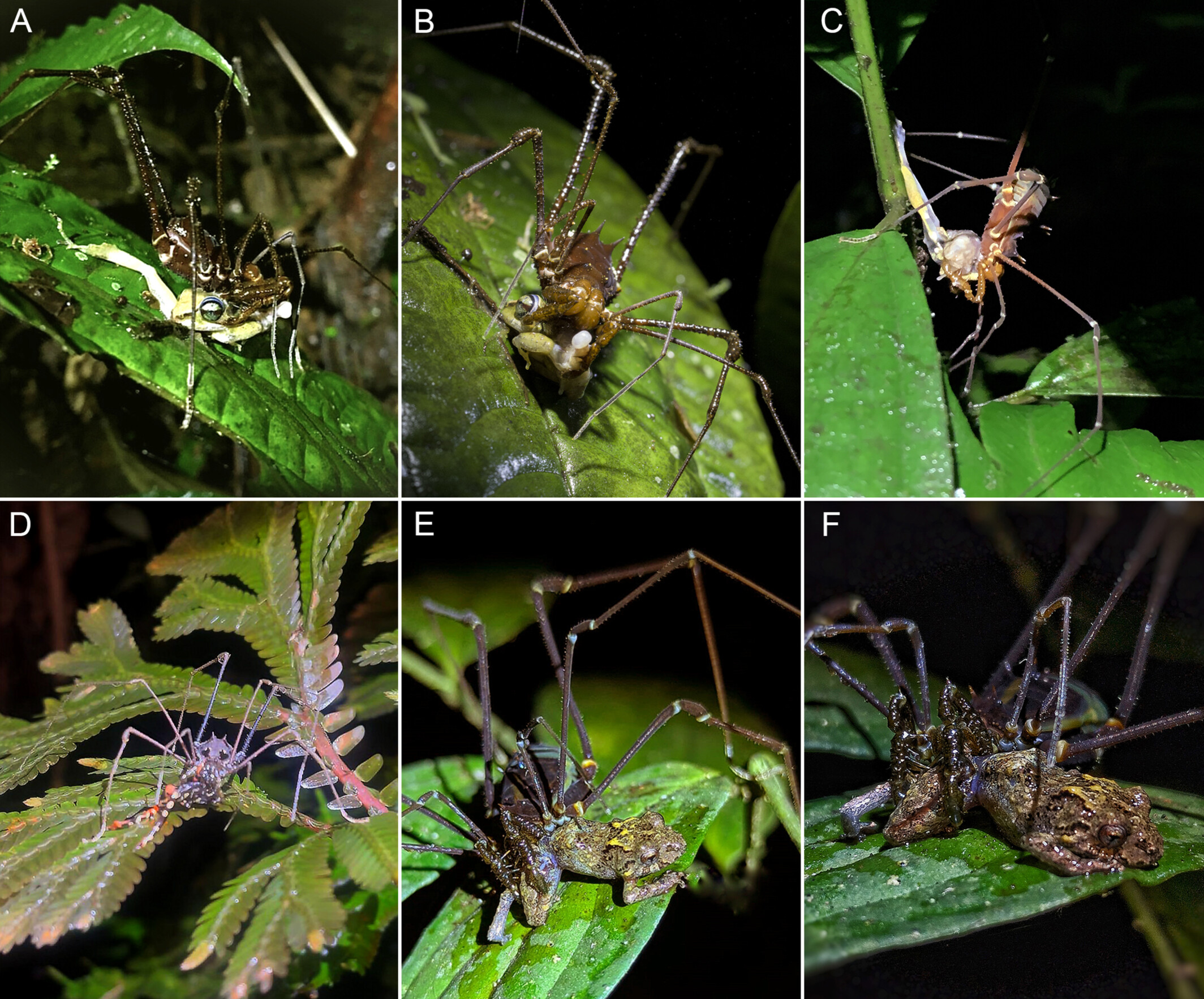
A final observation was made in Colombia, where the harvestman held the frog by the right hindlimb while consuming it. These interactions across different species of both frogs and harvestmen suggest that this method of predation may be more common than previously thought.
Despite their lack of venom, harvestmen make up for their size with spined pedipalps (mouthparts) and strong, armored bodies. They also exhibit sexual dimorphism, where large body size and pedipalps are associated with male-male competition. It could be suggested, therefore, that these traits translate well to the prey capture of large frog species, although only two of the examples could be recognized as male harvestmen while the other two could not be sexed.
The authors also suggest that occasional consumption of large prey like the frogs could be an important source of macronutrients for the harvestmen. Some species engage in energetically taxing behaviors such as egg guarding and remaining with their clutch, therefore limiting feeding opportunities.
The study is published in Ecology and Evolution.

 2
2