Space and Physics
 PUBLISHED
 1
1



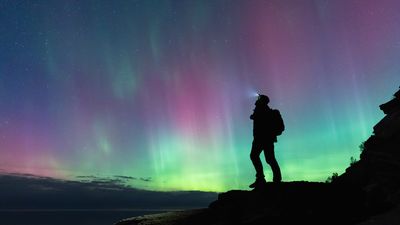


A coronal mass ejection, a sizable release of plasma, was thrown out by the Sun on Monday, March 16, and is about to hit our planet. When it does, the northern and southern lights will reach lower latitudes than usual. It might also affect some technologies, but nothing we should be too concerned about.
Starting from around 11 pm Eastern Daylight Time on March 18 and continuing for the next two days, there will be an increase in auroral activity. In the Southern Hemisphere, Tasmania and the South Island of New Zealand should receive some of the celestial spectacle, and it should be visible in the north of Scotland and across Scandinavia in the northern hemisphere. It will also be possible to see it low on the horizon from the Baltic countries, Germany, Poland, the North of England and Wales, and Ireland.
In North America, Canada and Alaska will get the show overhead, but plenty of states should get at least a partial view. It is possible the aurora will be visible low on the horizon in cities such as Salem, Boise, Cheyenne, Lincoln, Indianapolis, and Annapolis.
.gif "an animation show the activity of the Sun in th elast few days inclding the release of a large arc of plasma into space")
This might be the best chance for many people at lower latitudes to see aurorae for a long while. The Sun has now passed its point of maximum activity in its cycle. Just a few weeks ago, it experienced its first few days without sunspots in years. The flip of its magnetic poles has also settled. It will be quieter from here on out, as we approach a minimum in 2030. This doesn’t mean that we won’t get major events, but it is a lot less likely that they will happen.
An addition to this, around the equinox the relative orientation of Earth’s axis with respect to the Sun allows for more particles from the solar wind to slam into the atmosphere and create aurorae. With the equinox just days away, this coronal mass ejection had great timing.
The cherry on top is that the new moon is tonight, so there isn't even a thin crescent of our satellite to add extra light in the sky. If you find a northern spot with little light, you have an excellent chance to see a true spectacle.
You can follow predictions for the aurorae on the National Oceanic and Atmospheric Administration’s Space Weather Prediction Center and on the University of Alaska Fairbanks Geophysical Institute Aurora Forecast.