Health and Medicine
 PUBLISHED


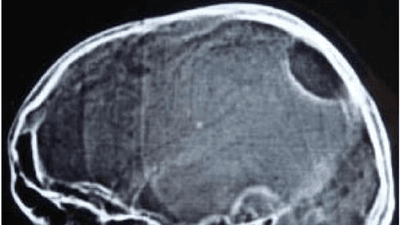


For the average human, bones are a pretty reliable part of their anatomy. Bar a few breaks here and there, you can generally count on them at the very least hanging around in your body, trapped in there by your muscles, fats, and various disgusting fluids that keep the body functioning. But for around 300 people that we know of, that's not a given – bones can sometimes "vanish".
The first case report of such an event appeared in the Boston Medical and Surgical Journal (now the New England Journal of Medicine) in 1838, concerning a man named only as "Mr Brown".
Brown, though there is very little information available about him, must have appeared to the doctors to have been a bit of a klutz. Or given that this was the 19th century, perhaps the doctors thought that he was subject to horrendous, arm-breaking, but back then acceptable working conditions.
Either way, at 18 he had fractured his upper right arm, and fractured it twice more before it had fully healed.
A fractured humerus is not as interesting as it is painful, and this by itself that would not make it into a medical case report. But later in 1838, upon re-examination by a doctor, it was found that the man now had no humerus there at all. Rather than healing, it had gradually disappeared. Despite this he retained pretty good function of his limb at the time of the first case report.
The missing humerus could not be confirmed via X-ray as they would not be discovered until 1895, but a later case report in 1872 showed that his humerus was not there the old fashioned way, following the man's death and subsequent autopsy.
Despite the rarity of this disease – called Gorham's disease or Gorham-Stout syndrome – there have been plenty of case reports since the discovery of X-rays and their medical use. If you find a patient whose bones have disappeared, you bet your ass the doctor is going to write about it.
One 52-year-old woman, for instance, suffered the "disappearance of her humeral head and a defect of the glenoid bone in her left shoulder joint" over the course of two months, limiting her joint function and necessitating a bone graft.
In another case a previously-healthy 14-year-old girl was suspected of having tuberculosis, but turned out to have Gorham's disease of the spine, requiring surgery.
The disease, known less formally as "vanishing bone disease" or "phantom bone disease", can affect any part of the skeleton, but more commonly affects the pelvis, shoulder, and cranium. Though clearly a distressing and painful experience, the disease is generally non-fatal, when it affects less important parts of the body.
"The clinical presentation depends on the site involved and many months or years may pass by before it is diagnosed. In some cases, the disease is manifested acutely, with incapacitating pain," a case report explains. "The first manifestations are commonly spontaneous fractures. In other patients, Gorham's disease presents an insidious course, with progressive muscle weakness."
So, what causes bones to vanish? Are they just being (shoot me) humerus? The answer is an unfortunate "we don't really know yet". To be more specific, we know that the bones are being reabsorbed into the body, and a likely mechanism behind it. It's not like these bones have literally vanished into thin air. But we do not know what triggers the disease to begin its odd line of work.
"Incidence of the disease may be linked to a history of minor trauma," a 2010 case report explains, "although as many as half of the patients have no history of trauma."
Your bones are not quite as static as is comforting. Of course as you grow your bones grow, it's not like you're born with an adult-sized skeleton after all. But once you've hit adulthood, that doesn't mean your bones are all set and fixed forever, a durable skeleton that will last you until your death. Instead, you get "remodeled".
"Much of the cellular activity in a bone consists of removal and replacement at the same site, a process called remodeling. The remodeling process occurs throughout life and becomes dominant by the time that bone reaches its peak mass (typically by the early 20s)," a report of the Surgeon General explains.
"Remodeling continues throughout life so that most of the adult skeleton is replaced about every 10 years."
Gorham's disease is largely thought to be due to overactivity of osteoclasts, specialized cells that play the part of breaking down bone before they are rebuilt by osteoblasts. If bones are missing, it makes sense to blame the bone-eaters, and this remains the most likely mechanism behind the disease.
However, according to the 2010 case report, "there is controversy even over the presence or absence of osteoclasts in the condition", and angiomatosis, a diffuse vascular lesion, has also been suggested as a possible cause.
The good news is that the condition is pretty darn rare, making it statistically nothing to worry about. For extra reassurance, most cases occur in people under 40. So if you've made it to that age, and all the worries about mortgages etc that that entails, at least you don't have to worry about your bones deciding to vanish on you.


 1
1