Humans
 PUBLISHED


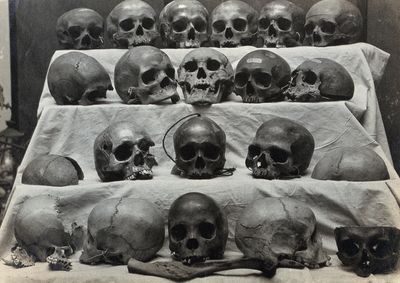


If you've ever looked at a black-and-white photograph from a bygone age and thought the people looked oddly different from people today, you might have put it down to the facial hair, the stiff posture, or the era's fashion. But new research suggests something more fundamental may also be at play: the shape of the human skull itself.
Scientists at the University of Tokyo collected CT scans of 56 skulls from the Kyoto University Museum belonging to people who lived in Japan during the late 19th to early 20th century, then compared them with those of 56 Japanese people who died in the 2020s.
By tracking 161 anatomical landmarks across each skull, they were able to map exactly how the human head has been reshaped over just a few generations.
The results showed clear differences between the historical skulls and the modern ones. Most significantly, the cranium has become rounder and wider, shifting from a longer, more oval shape toward a more spherical one. Modern skulls also have a noticeably larger mastoid process, which is the bony bump just behind the earlobe where neck and jaw muscles attach.
The changes were most pronounced in men, whose skulls had become more distinctively male over time. The mastoid bump and the ridge of bone at the base of the skull were both more prominent in modern men compared to their historical counterparts, meaning male and female skulls have grown more different from each other over the past century or so.
These processes have unfolded in such a short space of time that genetics and natural selection are not likely to be the culprits. Instead, the team believes the shifting skull shapes are a reflection of changes to nutrition, improved healthcare, and the shifting physical demands of modern life – similar to the forces that are generally making humans taller. Exactly which factors are responsible, and why men appear to be affected more than women, remains an open question.
"Although the exact causes of these changes, both the temporal differences and the increase in sexual dimorphism, are obscure, they may be related to well-known secular trends over the last century, such as increases in body size, changes in body proportions, and improvements in health due to better nutrition," the study's authors write.
"It is also possible that dietary changes, such as greater consumption of soft foods and the resulting reduction in chewing load, have contributed to modifications of the facial skeleton and mandible. Future research will be necessary to investigate the underlying causes of these changes in detail," they added.
The study only focuses on just a few dozen people from a single population, but it's not the first piece of research to reach these findings.
A 2012 research project by the University of Tennessee examined 1,500 skulls from the US dating back to the mid-1800s through the mid-1980s. Over the course of the 20th century, the skulls had become larger, taller, and narrower, while faces had become significantly narrower and higher.
A 2006 study went further back in time and looked at the skulls of 30 people who died in Britain between 1348 and 1349 during the Black Death, as well as 54 skulls recovered from the shipwreck of the Mary Rose, which sank in 1545. This showed that the cranial vault, the hollow space inside the skull that houses the brain, has grown by around 10 millimeters, while the face has become flatter in profile.
All of these studies suggest that the human skull is far more malleable than we might assume. If that’s true, it could have implications for how we approach archaeology, anthropology, medicine, and essentially any topic involving noggins.
“If modern human crania, and potentially other bones, have significantly changed in morphology in such a short period of time, this could mean that the methods we use are no longer as accurate as hoped,” Kimberly Plomp, a biological anthropologist at the University of the Philippines Diliman, who wasn’t involved in the study, told New Scientist. “This is fundamentally important for biological and forensic anthropology.”
The study is published in the American Journal of Biological Anthropology.