Nature
 PUBLISHED
 3
3


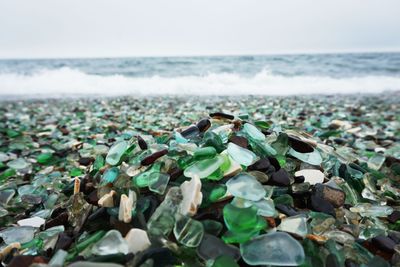


Perched on the rugged Mendocino Coast of Northern California, you can find a shore that‘s not scattered with sand nor stone, but billions upon billions of glass beads of all shapes and sizes.
Known simply as Glass Beach, it’s located just north of the town of Fort Bragg. It’s actually comprised of three separate beaches, but Glass Beach #3 is open to the public as part of MacKerricher State Park and is considered the most picturesque.
The beaches owe their existence to a chapter of recent history that would horrify modern environmentalists. Throughout much of the 20th century, Fort Bragg residents used the coast as a municipal dump, chucking everything from household glass and ceramics to appliances and old cars directly into the Pacific Ocean and its shores. It wasn’t until 1967 that local authorities outlawed the practice and removed many of the large metal objects from the beach.
Over the years, the constant crashing of the Pacific waves weathered the bits of glass bottles, pottery shards, and ceramic plates, stripping them of their sharp edges and frosting their surfaces into jewel-like pieces of sea glass.
Amber and green tend to form from old beer and soda bottles, while white and clear pieces derive from window glass and mason jars, and soft lavender hues emerge from old manganese-tinted glass that has been slowly altered by decades of UV exposure from the California sun. One of the rarer colors is cobalt blue, which comes almost exclusively from old Milk of Magnesia bottles, Noxzema jars, and tubs of Vicks VapoRub.
Beyond its glassy shores, the beach has a beautiful backdrop as it sits at the edge of one of the most geologically dramatic coastlines in North America. The Mendocino Coast lies near the Mendocino Triple Junction, the point where three tectonic plates – the Pacific, North American, and Juan De Fuca – grind against one another in a slow, perpetual collision. This tectonic violence can be felt in its coastline, which is packed full of rugged headlands, sea stacks, and wave-carved coves.
Today, however, the beach is a shadow of its former self. Collecting glass is officially prohibited within MacKerricher State Park, but it's widely evident that visitors routinely ignore the ban and pocket souvenirs.
A local group affiliated with the Sea Glass Museum warns that Beach #3 has been significantly depleted in recent years and has become far less colorful than it was even a generation ago. They argue that the bans on glass collecting have simply failed, and that the only realistic path forward is to artificially replenish the beach with new glass beads.