Space and Physics
 PUBLISHED




The night sky is dark – but it’s not as dark as it could be. The moon shines bright; stars abound to a seemingly paradoxical degree; if you look up from the right place, at the right time, you can even see the core of our own galaxy stretching lazily out above you.
But not all cosmic lights are so dramatic. Zodiacal light, for example, makes you wait – and once it’s arrived, you still have to work for it. The zodiacal band is even more coy than that, visible only to those far from any light pollution and squinting hard. But worst of all? The gegenschein – a light so faint and mysterious that even its discovery is a point of contention.
What is the gegenschein?
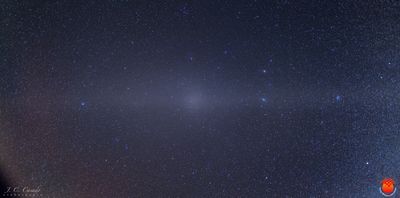
Sitting in the sky directly opposite the Sun, there’s a small, extremely faint spot of light. It’s not easy to see – it’s so faint and elusive that, unlike the zodiacal light with which it’s so closely associated, nobody seems to have even noticed it until the 19th century.
That’s the gegenschein: a “faint, oval spot of light that may be visible in a very dark, clear sky, at the anti-solar point,” explained astrophotographer and astronomy communicator Mary McIntyre in 2023.
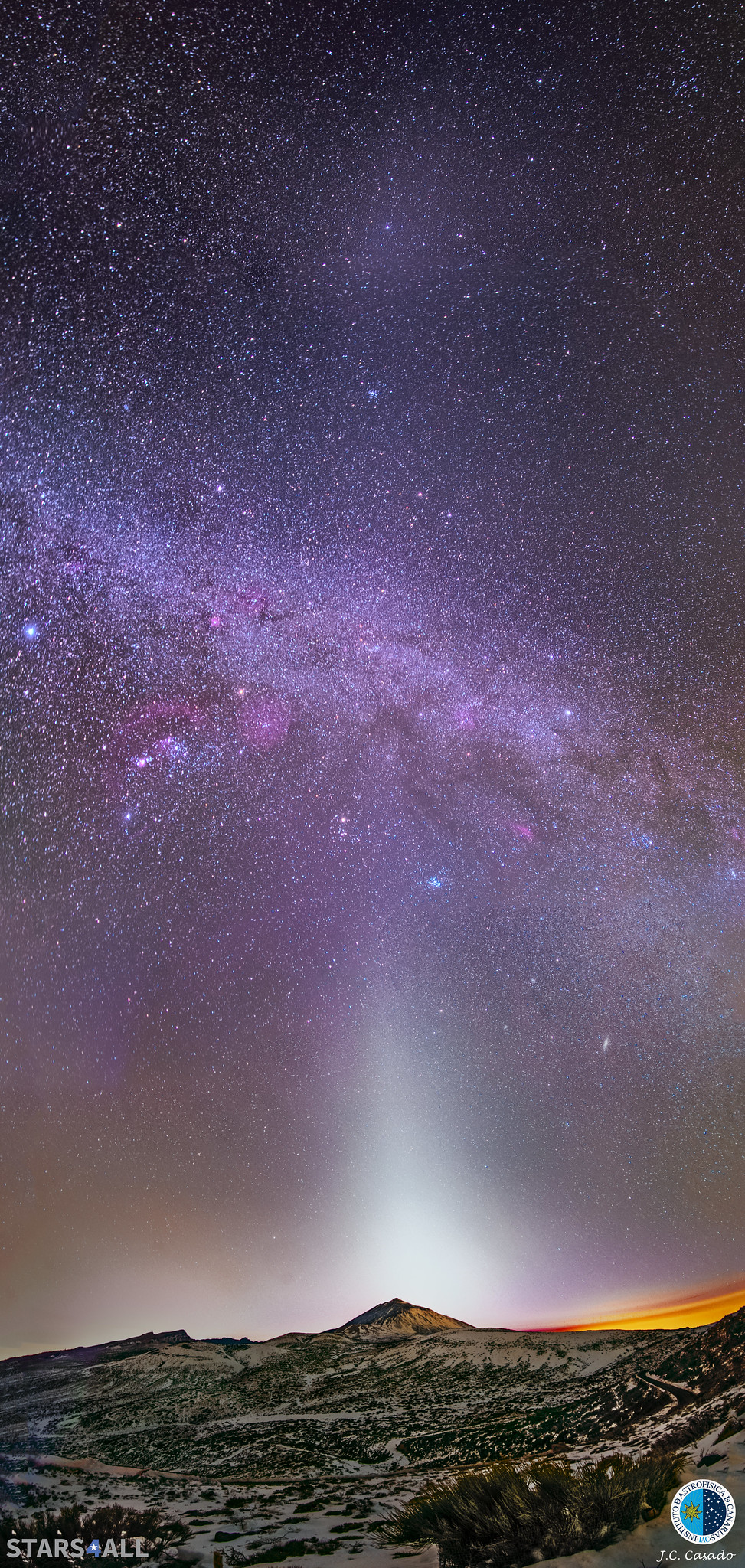
“[The Gegenschein] is closely associated with zodiacal light, and both are caused by sunlight being scattered by a disc of interplanetary dust,” she told HowStuffWorks. “This disc of dust extends out probably beyond the orbit of Jupiter, and the individual dust particles are tiny; between 3.9 and 0.01 inches (0.001 and 0.3 millimeters) across.”
But if they’re both caused by the same thing, you might ask, then why is the gegenschein so much fainter than the zodiacal light? The answer comes from the angle at which sunlight is being reflected: zodiacal light, being near the Sun from our perspective, reflects light at small angles towards us; the gegenschein, meanwhile, can only reflect light at 180° – an effect known as the “opposition surge”.
“The opposition surge is the brightening of a rough surface or an area that contains many small particles when it is illuminated from directly behind the person observing it,” McIntyre explained. “In astronomy, planets are best observed when they are at opposition, or the point in the sky directly opposite the sun.”
“A more common example that we see each month is the full moon,” she added, “which is fully illuminated by the sun on the opposite side of the sky.”
Discovering the gegenschein
The earliest mention we have of the gegenschein – or, to be more precise, the Gegenschein, with a capital G – comes from 1803. “Gegen 10 Uhr war das Zodiacallicht hier in der Südsee gewöhnlich schon sehr schwach, um Mitternacht sah ich nur eine Spur desselben. Wenn es den 16 März am stärksten leuchtete, so ward gegen Osten ein Gegenschein von mildem Lichte sichtbar,” read the records of German polymath Alexander von Humboldt. Or: “Around 10 o’clock, the zodiacal light here in the South Pacific was usually already very faint; at midnight I saw only a trace of it. When it shone brightest, on March 16, a counterglow of gentle light was visible towards the east.”
That “counterglow” – a term that’s still occasionally used in English – must have been unusually bright when von Humboldt glimpsed it. Normally, “the gegenschein is one of the most elusive faint glows in astronomy,” noted Donald Olson, an astrophysicist, forensic astronomer, and so-called “Celestial Sleuth” at Texas State University, back in 2021. “It’s near the limit of human vision.”
It’s perhaps not so surprising, then, that the first mention of it by name is barely more than 200 years old – earlier observers just didn’t clock it. But here’s the twist: while he may have been the one to name the phenomenon, von Humboldt might have been looking at something entirely different.
“It’s not clear what Humboldt actually saw,” Olson wrote. “He described luminous pyramids near both the western horizon and the eastern horizon during the early evening, not near midnight when the oval of the gegenschein is high overhead.”
So, if not von Humboldt, then who? The common story is that von Humboldt was beaten to the punch, by some 70 years or so, by the French Jesuit astronomer Esprit Pézenas. It was he who, in 1730, reported “a great light along the zodiac […] extend[ing] obliquely, nearly according to the position of the zodiac, and form[ing] a kind of belt” in the sky. Slam dunk, right?
Well, some of the details worked – whatever he saw was in the right place to be the gegenschein, at least, and it sounded sort of the right shape. But past that, things get hinky: Pézanas noted that he saw the light before 8pm, and it had disappeared by 11 – “exactly the opposite behavior expected from the gegenschein,” Olson pointed out. Perhaps most damningly, he described the light as being a “bright red” – “but the gegenschein is so faint […] colors are difficult or impossible to detect,” Olson said. “He shouldn't be perceiving bright colors.”
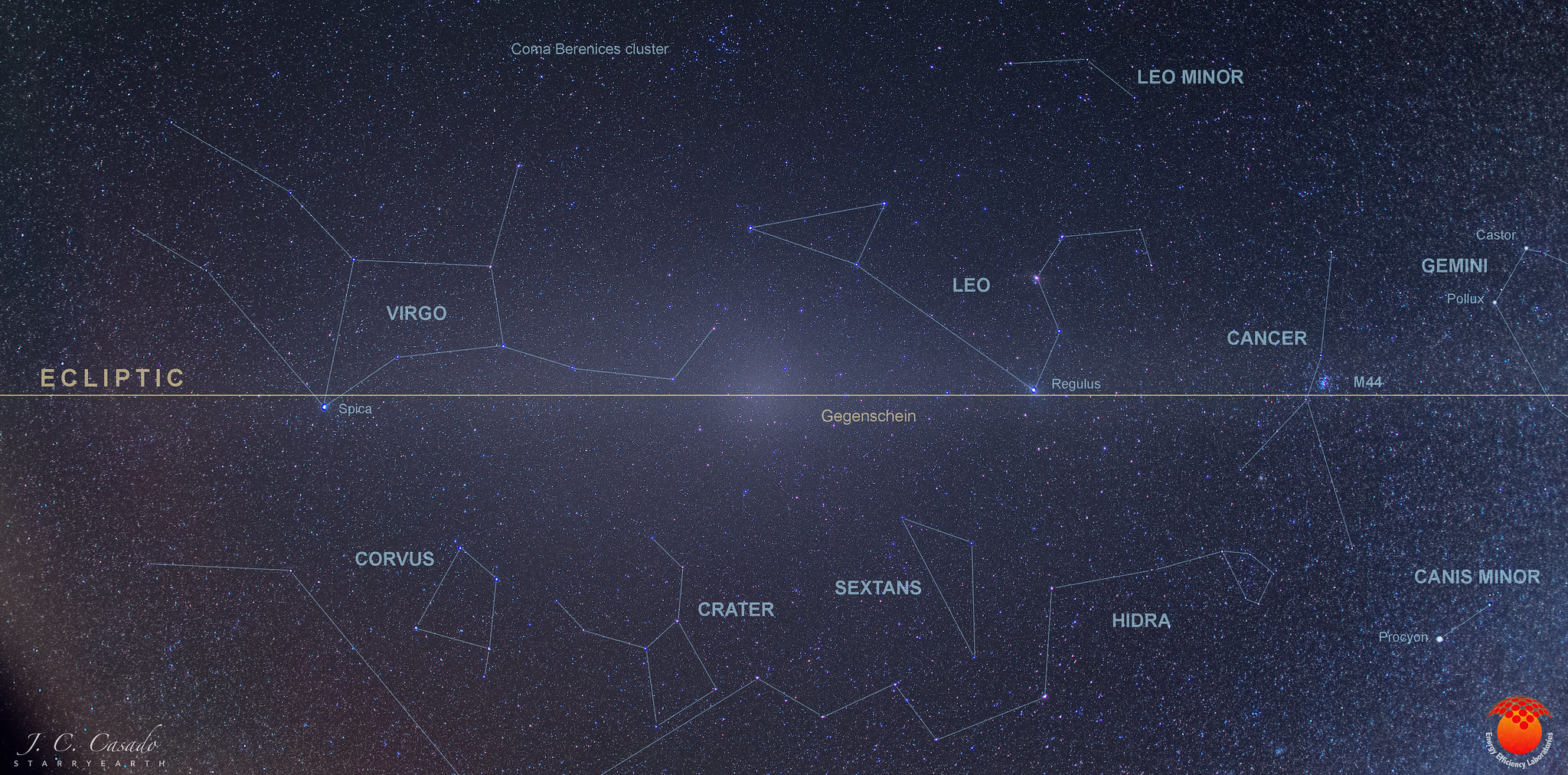
The most likely explanation, Olson said, was that Pézanas had witnessed an aurora, albeit a particularly well-placed one. And that leaves just one name for the potential discoverer of the gegenschein – and, luckily, this one is indisputable.
“The first observer to give a clear and accurate description of the phenomenon was in fact Theodor Brorsen in 1854,” Olson wrote. He cited von Humboldt, and borrowed the name from him – but most likely, they were looking at different things. And there’s no guessing with Brorsen: he didn’t only describe the gegenschein exactly correctly, reporting “a brighter elongated round patch […] the middle of it coincid[ing] almost exactly with the point opposite the Sun”, but he also repeated his observations for years, leaving no doubt as to what it was he was looking at.
How to see the gegenschein
If you’re hoping to see the gegenschein – well, don’t get your hopes up. “Because it is so faint, the gegenschein is visible to the naked eye only from very dark skies,” wrote mathematician and astronomer Douglas Heggie in a 2023 article for the Astronomical Society of Edinburgh. “I have seen the zodiacal light on two occasions, but have never seen the gegenschein.”
Still, there are a few tricks and techniques you can use to help. Timing is important: “You will have more chance of seeing the gegenschein during the winter months,” McIntyre said, “because the antisolar point will be at its highest point at local midnight.” Finding that point is easier with the use of stargazing apps and software, she added.
Aside from that, you’ll need the clearest skies possible: no light pollution from nearby towns and cities; no cloud or fog; even moonlight will likely wash out the sky too much to see gegenschein. You shouldn’t expect to see it immediately – your eyes will need 20 or 30 minutes to adjust to the dark.
And if you still can’t see it? Try averting your vision. “This is a trick astronomers use frequently to view faint objects,” McIntyre explained. “Just look slightly off to the side of an object and the more sensitive cells in your eye, the rods, will allow you to see the object in your peripheral vision more brightly than when you look directly at it.”