Space and Physics
 PUBLISHED


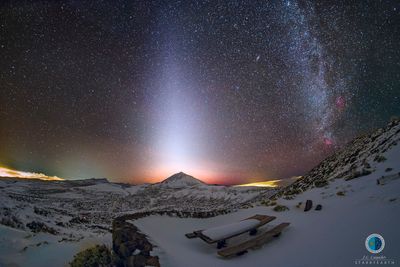


Cast your eyes skyward of an evening this month, and you might see something a bit eerie. The zodiacal light – so called because it appears within the same belt of constellations as the zodiac signs (and is a light) – looks like a huge ghostly pyramid in the sky, its vertical axis tilted relative to the horizon. Right now, around the equinox, is the best time to see it. Here’s what it is, and how to find it.
What is the zodiacal light?
You may well have seen this cosmic phenomenon before, and not realized it – perhaps you confused it for light pollution from a city on the horizon, or a particularly diffuse alien abduction. Maybe you thought it was just the last remnants of the sunset: not for nothing is the effect sometimes known as “false dusk” – or, at the other end of the year, “false dawn”, as it turns up in the morning instead of the evening.
Because of that, whether you’ll be looking at the fake day’s end or start this month depends on where you live. In the Northern Hemisphere, it’ll be at dusk; in the Southern Hemisphere, where it’s currently Fall, it’ll be at dawn.
But don’t be fooled: the zodiacal light “will look like a mostly vertical column or pyramid” with “a soft, triangular, pearly glow,” Geza Gyuk, an astronomer at the Adler Planetarium in Chicago, told National Geographic back in 2010. The “true [dusk]”, meanwhile, is “horizontal”.
Thanks to its mysterious appearance and auspicious timing, zodiacal light has long fascinated stargazers. Representations of the phenomenon can be seen in Ancient Egyptian art; mentions of “glowing beams” in Ancient Greece and Rome, and the “wings of the morning” in the Tanakh, are also thought to reference zodiacal light. In pre-Columbian Mesoamerica, it was sometimes recorded in historical legends as a harbinger of doom; it holds an important significance in Islam, being specifically called out in Hadith for misleading worshippers over the timings of their daily prayers.
The astronomer Giovanni Domenico Cassini – he of Saturnian probe fame – thought he’d discovered it for the first time ever in 1683, reporting in a famous paper two years later the sighting of “one of the rarest spectacles ever observed in the sky[:] A light similar to that which whitens the path of milk, but brighter in the middle and fainter towards the extremities, spread by the signs that the Sun must traverse in this season.”
Of course, he certainly wasn’t the first person to notice zodiacal light – but he may (keyword: may; there’s a bit of controversy here) have been the first to propose a scientific explanation for it. And kind of incredibly, he – and if not he, then at least his pal Nicolas Fatio de Duillier – wasn’t too far off.
What causes the zodiacal light?
In 1684, Fatio de Duillier posited the following: the zodiacal light, he said, was simply the reflection of light off particles circling the sun.
He wasn’t wrong: it’s technically a cloud of interplanetary dust, “roughly the size of cigarette smoke particles” and spanning the inner Solar System between Mercury and Jupiter, Brian Skiff, a research scientist and astronomer at Lowell Observatory, told National Geographic this year. But precisely where that cloud originates is much less straightforward: Cassini hypothesized that it might have been ejected from the Sun; some later astronomers suggested it was due to a vast dust belt around the Earth itself, rather than the Sun. Neither was correct.
For a long time, it was concluded that the dust came from asteroid collisions near the Sun – but this hypothesis came with a problem. The observational evidence supported it, but the mechanics didn’t seem to make sense: the only way to make such a big, thick dust cloud from asteroids was if they had originally come from around Jupiter – but those rocks would probably never make such a cloud, since they would likely be swept up in Jupiter’s massive gravitational pull.
It wasn’t until 2010 that a solution was found: the dust came not from asteroids, but comets, breaking down through various space and physics phenomena and being pulled inwards by the Sun’s radiation pressure. Further evidence from various NASA missions confirmed this – and then, in 2020, a surprise: some of the dust, it appeared, came from Mars.
“We thought, ‘Something is really wrong,’” said John Leif Jørgensen, a professor at the Technical University of Denmark who accidentally made the discovery while trying to track the path of NASA’s Juno spacecraft. “The images looked like someone was shaking a dusty tablecloth out their window.”
The huge amount of dust they were seeing orbited the Sun in a near-circular orbit – and “the only object we know of in almost circular orbit around 2 AU is Mars, so the natural thought is that Mars is a source of this dust,” Jørgensen explained at the time. “That’s the dust we see as zodiacal light.”
But, while Mars is certainly “the dustiest planet we know of” – those are NASA’s words, so you know it’s legit science – the jury’s still out on exactly how all that dust could have escaped its gravity to form this huge interplanetary cloud. History, they say, doesn’t repeat – but it certainly does rhyme.
How, when, and where to see zodiacal light
Just like Elphaba, if you care to find the zodiacal light, look to the western skies. The phenomenon appears as “a cone-shaped wedge of light rising from the sunset point in the evening,” Skiff explained; “The ecliptic is tilted nearly vertically to the horizon, so the band suffers the least effects from any interfering glow closer to the horizon.”
The effect is best to see now, while we’re close to the Spring equinox – look for it about 90 minutes to 2 hours after sunset, Skiff advised. The light isn’t overwhelmingly bright, so you’re going to want to go somewhere with little-to-no light pollution and a clear, unobstructed western horizon. If you still can’t see it, you might want to try a technique called “averted vision” – look slightly away from the phenomenon, rather than directly at it. This makes the light fall on the outer part of your retina, which is more sensitive than the center, and can pick up fainter signals.
If you’re really lucky, there are two other things to look out for: the zodiacal band – an extremely faint band of light that sits in the same patch of sky, sometimes merging with the zodiacal light – and the gegenschein, a faint oval patch of light sitting diametrically opposite the Sun. Both of these are also due to interplanetary dust, but neither is as easy to see as the zodiacal light.
Unlike some cosmic phenomena – mentioning no names, but it rhymes with Schmaurorae – this is one effect that’s best seen closer to the equator. If you live in these latitudes, you don’t need to wait until the equinox to see either false dawns or dusks – they’re visible year-round, thanks to the favorable ecliptic angle from that location.