


 Nature
 PUBLISHED


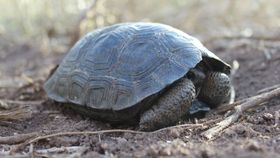


For the first time in more than a century, giant tortoises have bred successfully on the Galapagos island of Pinzón. The announcement raises hope for preserving some of the diversity that inspired Darwin's theory of evolution.
Although Pinzón is one of the smaller islands in the Galapagos, it is located at the center of the archipelago and its ecology has suffered from many of the same problems seen elsewhere. In the mid-19th century, black rats hitched a ride on sailing ships and proceeded to take over the island. Even a pack of rats are not up to taking on a fully grown giant tortoise, but they proceeded to eat every egg and hatchling laid on the island.
Any shorter-lived species would have been wiped out, but the tortoises live so long that adults have just kept plodding on, waiting for something to save the species. In the 1960s, conservationists collected all the unhatched eggs they could find on the island and incubated and raised them on another island. Five years later, the tortoises—now large enough to resist the rats—were returned to Pinzón.
This bought the tortoises another few decades, but clearly was not a long-term solution. So in 2012, Galapagos National Park rangers dropped poison baits to lure rats on the island, provided treats they hoped would distract the tortoises and crossed their fingers. The rats took the bait and this year Nature has reported that ten newly hatched tortoises have been sighted.
Credit: James Gibbs. Tasty cactuses were used to distract tortoises from the rat baits.
Professor James Gibbs of the State University of New York was one of those who observed the glad tidings. He did so as part of a survey that found 300 adult tortoises, leading to an estimate that 500 survive on the island.
The salvation of any species is exciting in these dark times, but the Pinzón operation has some extra features. The Dodo describes the event as a first-of-its-kind operation, with potential to be applied to many other isolated island ecosystems.
Moreover, the observation of Mr. Lawson, a vice-governor in Darwin’s day, that he could tell which island a tortoise came from by the shape of its shell was a key moment in the development of Darwin's thinking. Pinzón, being a relatively dry island, is inhabited by saddleback tortoises of the species Chelonoidis duncanensis. Amazingly, these are one of the smaller Galapagos species.
Credit: James Gibbs.
Across the islands, tortoise populations plunged from several hundred thousand to around 3,000 in the 1970s before rebounding to around 15,000 today. Hopefully, those numbers will still soon start to rise again.
H/T Aol



 1
1