Nature
 PUBLISHED
 4
4


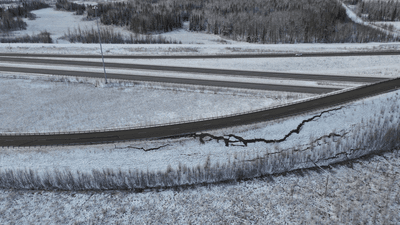


Frost quakes, like the ones that struck a city in Finland 26 times in just seven hours, could become more common if the climate crisis continues to cause extreme weather in cold regions. Also known as cryoseisms or ice quakes, these peculiar and understudied weather phenomena are triggered by water freezing in saturated rocks or soil.
The mechanism behind frost quakes means they impact areas where there’s lots of moisture in the earth, often near bodies of water. Then, when there’s a sudden drop in temperature, the water can freeze and expand rapidly, creating stress within the surrounding substrate.
Frost quakes occur when this stress becomes so great that it creates a fracture, shaking the ground. Like an earthquake, frost quakes can be felt and heard, but they don’t reach the same extremes of magnitude. Many frost quakes go unnoticed because they’re so subtle, while others create sounds similar to gunshots and can even cause damage to physical structures like buildings.
However, as YouTube videos demonstrate, they're not always terribly dramatic...
By their very nature, frost quakes are connected to the extremes of weather – something we’re seeing more of as the climate crisis has unfolded in recent decades. As such, researchers were interested to know how climate change may affect Arctic and sub-Arctic regions, including frost quakes. They reported their findings at the European Geosciences Union General Assembly.
Recent reports from frosty regions like Finland, Canada, and the US have demonstrated the damage these quakes can cause to infrastructure, so it’s a weather phenomenon worth getting to know if we’re going to keep safe during increasingly unpredictable conditions.
To do so, researchers established a model that enabled them to investigate the connection between thermal stress and frost quakes. Thermal stress is related to the stress created by any change in the temperature of a material that causes it to expand and contract, such as the impact of freezing water in saturated soil.
They used a hydrological model to calculate snow depth, snow melt rate, and soil temperature at different depths in the soil and explore what happens when the temperature suddenly changes. This revealed that a rapid decrease in temperature can cause thermal stress strong enough to shatter a soil-ice combo, resulting in the bangs and cracks we’ve observed following frost quakes.
In 2016, Oulu in Finland experienced a rash of frost quakes, as 26 hit the sub-Arctic environment within a seven-hour window. The quakes broke the soil and damaged the foundations of buildings and roads.
Using their models, the researchers of this new paper could calculate that the quakes were triggered by a temperature drop of 17 degrees Celsius (30.6 degrees Fahrenheit) as the cold plummeted from –12 degrees Celsius (53.6 degrees Fahrenheit) to a thermally stressful –29 degrees Celsius (84.2 degrees Fahrenheit) capable of cracking frozen soil and pavement.
Understanding the tolerance of different substrates may enable researchers to predict areas that could be affected by frost quakes when particularly turbulent weather is expected, perhaps leaving towns and cities better able to prepare.
So, get familiar with “cryoseisms”, kids. It looks like we could be seeing more of these frosty characters in the future.
[H/T: New Scientist]