Humans
 PUBLISHED
 8
8


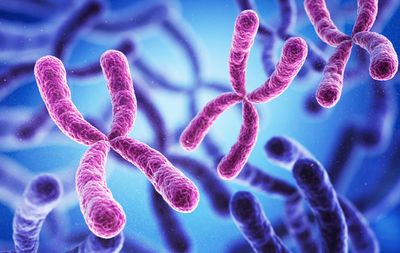


Using a new technique that makes it easier to precisely measure the number of chromosomes in ancient DNA, researchers have identified the earliest known cases of two genetic disorders.
Ancient DNA can provide us with useful insights into our ancestors, but unfortunately, samples can degrade or become contaminated over time, making it more difficult to analyze. One of the problem areas is in detecting differences in the number of chromosomes, such as extra or missing copies – this is known as aneuploidy.
To combat this, the research team developed a new computational method to detect more variation when counting the number of chromosomes, particularly the X and Y (also known as the sex chromosomes) in a human genome. Most human cells have 23 pairs of chromosomes, including the sex chromosomes. Females usually have two Xs (XX), whilst males have an X and a Y (XY).
The new method was applied to a dataset from the Thousand Ancient British Genomes project and identified five individuals with sex chromosome aneuploidies, two of whom are the earliest known people to have had a genetic disorder.
“Through precisely measuring sex chromosomes, we were able to show the first prehistoric evidence of Turner syndrome 2,500 years ago, and the earliest known incidence of Jacob's syndrome around 1,200 years ago,” said Kakia Anastasiadou, first author of the study describing the findings, in a statement.
Turner syndrome is characterized by one X chromosome instead of the usual two, while Jacob’s syndrome is characterized by an extra Y chromosome.
Aneuploidy in sex chromosomes can sometimes affect development; the bones of the individual with Turner syndrome indicated that they had not gone through puberty or menstruation, though they were believed to have been around 18 to 22 years old. However, analysis also revealed that only some of the cells had just one copy of the X chromosome, whilst others had the usual two. This is known as mosaicism.
The study also identified three people with Klinefelter syndrome (an extra X chromosome, XXY) who lived in a range of time periods. An infant from the Iron Age was also revealed to have Down syndrome, the result of an extra copy of chromosome 21 – this is an autosomal aneuploidy, meaning it affects a chromosome that isn’t a sex chromosome.
“It’s hard to see a full picture of how these individuals lived and interacted with their society, as they weren’t found with possessions or in unusual graves, but it can allow some insight into how perceptions of gender identity have evolved over time,” said Anastasiadou.
Pontus Skoglund, fellow author and evolutionary geneticist added: “Our method is also able to classify DNA contamination in many cases, and can help to analyse incomplete ancient DNA, so it could be applied to archaeological remains which have been difficult to analyse.”
“Combining this data with burial context and possessions can allow for a historical perspective of how sex, gender and diversity were perceived in past societies. I hope this type of approach will be applied as the common resource of ancient DNA data continues to grow.”
The study is published in Communications Biology.