Humans
 PUBLISHED
 4
4


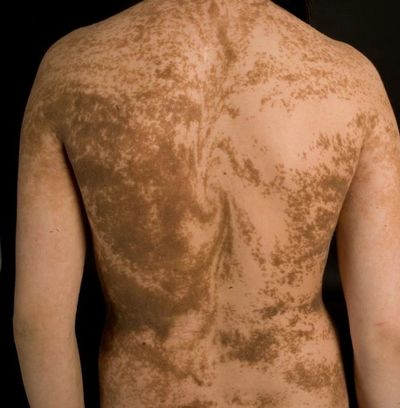


It might not look like it, but you’re going to have to trust us on this one: human skin is covered in stripes. Called the lines of Blaschko, or Blaschko lines, it’s thought they map the movements of cells from when the body was developing in the womb. This mysterious pattern only becomes visible under some very specific circumstances.
The first person to describe the lines is who they're named after. Alfred Blaschko was a German dermatologist who collected data from a group of patients with certain skin conditions, mapping the distributions of lesions on their skin. In 1901, he presented his findings at a conference. Other patterns do exist on human skin – Langer lines, for example, are used when planning surgical incisions – but Blaschko’s lines didn’t match any other patterns or structures that were known about.
Over 100 years later, scientists agree the most likely explanation is that Blaschko lines trace the paths formed during embryonic development, as skin cells migrated and proliferated. Blaschko himself is said to have traced the lines onto a Greek statue that he displayed in his study, but our budget wouldn't stretch to defacing priceless artifacts so we'll make do with this diagram.

You can see how the lines never cross the anterior midline, the imaginary boundary running the length of the chest and abdomen along the front of the body. At the back, they form a characteristic V-shape, and there are wavy lines along the limbs and around the head and face.
A range of skin conditions can cause lesions and pigmentation that follow the Blaschko lines when they appear on the body. These include acquired disorders, such as lichen striatus, as well as genetic conditions like incontinentia pigmenti and McCune-Albright syndrome.
Skin lesions that map to the Blaschko lines are an example of cutaneous mosaicism. Genetic mutations in a subset of skin cells mean that the body effectively now contains two different populations of skin cells with different genetic material. Where those two different cell lines meet, lesions form along the Blaschko lines.

One specific form of mosaicism is chimerism. In chimeras, the two different sets of genetic material are derived from two different fertilized eggs. While mosaicism is quite common, chimerism specifically is very rare in nature. In humans, for example, chimeras can sometimes arise when one fraternal twin absorbs its sibling while the embryos are developing in the womb. The surviving twin may not even be aware of their unusual genetic makeup until much later in life.
One of the key signs of chimerism is differences in pigmentation. Chimeras can have different colored eyes, and may also have patterns of skin pigmentation that follow the lines of Blaschko.
Being informed that your skin is decorated with invisible stripes might, understandably, spark the imagination. One persistent rumor suggests that the lines of Blaschko can be viewed under UV light, and that cats can see them.
However, if you think Felix has been perceiving you as some sort of giant bipedal tiger all this time, we’re going to have to disappoint you: incredible though cat eyesight may be, we haven’t found any convincing evidence that they can see our stripes.