Health and Medicine
 PUBLISHED


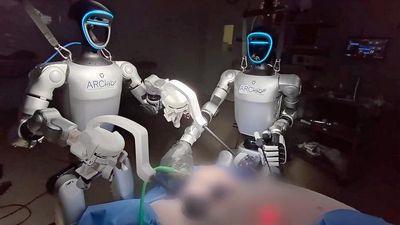


In a world first, robots built with human-like forms have performed two surgeries on live pigs, once with the robot assisting a human surgeon, while in the other case two robots worked together. Further work is required, but it is hoped these flexible robo-surgeons could bolster medical services in remote locations, such as Antarctica or even space.
Robots already have a major role in surgery. If you have a knee reconstruction, for example, there is a good chance the surgeon will be assisted by a machine they will call a robot. However, these mechano-surgeons don’t fit the image science fiction has given us of robots, and people may be expecting something more akin to Tesla's long-promised Optimus Primes.
An extra pair of "hands"
Existing surgical robots are built to perform one, or at most a few, roles. The one that fixes knees would probably be unsuited to taking out an appendix, for example. Professor Michael Yip of the University of California, San Diego, is trying to develop something more flexible, and for that it makes sense for the product to be shaped much more like us.
Yip and colleagues in the engineering faculty worked with doctors to modify the Unitree G1 humanoid robot, a commercially available platform, for surgical purposes. They tested it first by having both novices and surgeons use it to perform lab-bench tasks designed to develop surgical skills, such as moving pegs and replacing O-rings.
The robot, known as Surgie, under the remote control of a senior surgeon, then assisted a surgeon in removing a gallbladder from a live young pig. Having passed its apprenticeship, Surgie and a mechanical colleague removed another pig’s gallbladder together. Both operations were successful, although there was minor bile spillage and liver-bed bleeding in the second case.
Gallbladder removal is a form of laparoscopic surgery, where everything is done by pivoting through a small insertion point.
The authors report that surgeons rated the robot better at the bench tasks on measures like effort and frustration than doing the same tasks manually, but ranked it behind using an existing machine designed specifically for laparoscopic work. Novices had similar reactions, which also translated to the accuracy of their work.
Patients may be reluctant to have a robot lead their operations, and it’s questionable whether a thing of steel and wires will have the bedside manner that has been shown to play an important part in recovery. However, with surgeons often in short supply, Yip hopes these machines can start off by supporting experienced surgeons in operations that require more than one pair of hands.
“Remotely operated and autonomous humanoid robots have real potential for amplifying access to critical surgeries to which patients would otherwise not have access. This can help address the healthcare crisis not only in the United States, but also worldwide,” Yip said in a statement.
Surgery in space?
“Worldwide” may only be the start of it. Space missions require such a range of skills that it will be rare to be able to squeeze in a surgeon in case something goes wrong. At 27 kilograms (60 pounds), Yip’s robots not only weigh less than a human, but they can do without food, water or air, let alone a space suit, so the launch costs should be far less than a human.
Better still, one could sit in the corner of the International Space Station (ISS) or NASA's proposed Moonbase for years until needed.
Doctors on Earth have already operated robot arms on the ISS, and ”holoported” onboard for training or psychological counseling. Combined with the recent demonstration of diagnostic X-rays in microgravity, space could be on the way to becoming a better place to get sick.
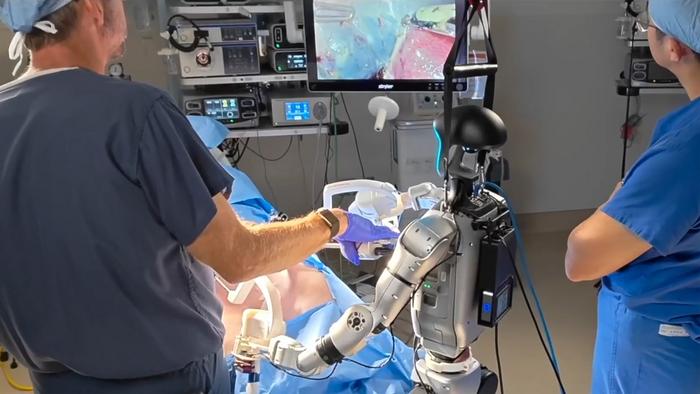
"Surgie" to the rescue
"This study shows that humanoid robots have a viable future in the field of surgery. You can imagine these robots being deployed in remote communities where staffing is challenging, or in austere environments like search and rescue scenarios where a massive deployment of field medicine is needed in a short period of time,” Yip said.
Surgie comes with adaptors to operate the same tools human surgeons use. “We were surprised at how well Surgie meshed with our workspace and workflow,” said surgeon Dr Nikita Thareja.
The team confirmed that when Surgie is operated remotely by a human, it achieves the same precision as established surgical robots, but across a far wider range of tasks. Moreover, “It's a fraction of the cost and it takes a fraction of the space in an operating room. So it’s easy to deploy, anywhere from rural areas, to the battlefield, and even to space,” Dr Shanglei Liu, who controlled Surgie on its first outing, said.
Despite these advantages, Surgie is far from ready to put doctors out of a job. During the trials, several recalibrations were required, making the process much slower than if another doctor had filled the role instead, or even if a surgeon had used a robot specific to the type of operation.
Nevertheless, the team notes that existing medical devices have usually experienced similar initial problems. Surprisingly, it’s also harder to maintain sterility with Surgie than a human, as the hands’ motion calibration would be damaged by an autoclave.
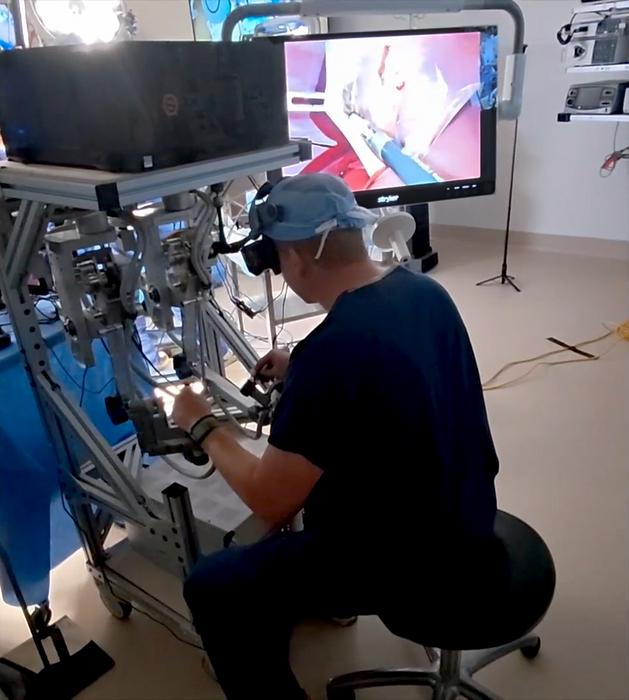
Even before Surgie is ready to take charge, it could perform a lot of other roles, such as fetching tools. Unlike most humans, Surgie won’t mind cleaning the blood and pus out of the operating room.
“One of our goals is to develop the autonomous surgical assistant,” Yip said.
“Many communities struggle with adequate staffing on the surgical team, which means patients are not being treated. Our goal is an operating theatre of the future, where humanoid robots and humans work side by side as an integrated team to deliver procedures to those in need, both in traditional hospital settings as well as in non-traditional, field medicine scenarios.”
The trial has been reported in Nature, and more information is provided on the project website.