Health and Medicine
 PUBLISHED



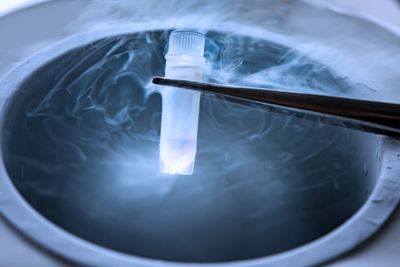


For the first time, frozen testicular tissue collected from a patient when they were a child has been successfully transplanted back into them as an adult and found to produce sperm. The groundbreaking trial demonstrates a proof of concept that could, in the future, help men who have undergone chemotherapy or other medical procedures in childhood retain their fertility in adulthood.
Scientists in the lab of Ellen Goossens at Vrije Universiteit Brussel in Belgium have been working on approaches to restore fertility in men for a number of years. Now the team has released a new case report as an unreviewed preprint, detailing the successful re-implantation of testicular tissue that had been cryopreserved since it was harvested in 2008.
The patient had his testicular tissue harvested and frozen at the age of 10 before undergoing a lengthy course of treatment for sickle cell disease, involving three years of chemotherapy and an eventual bone marrow transplant to cure the condition. Now, at 27, his tissue has been successfully defrosted, re-grafted back into his body, and found to be producing sperm.
“This is a huge finding. Many more people will have hope that they can have biological children. It's great to see for the patients for whom we already have tissue banked,” Goossens told The Guardian.
In cases where someone has to undergo a course of treatment, such as cancer treatment, that could damage their reproductive system, there are several options for preserving fertility. Both sperm and egg cells can be harvested and cryopreserved, and in younger girls, it may be possible to preserve ovarian tissue and offer the hope of a successful pregnancy in the future.
However, for prepubescent boys, who have not yet started producing sperm, there are no widely available options. Harvesting testicular tissue offers the chance of preserving their fertility for later in life, but it wasn't clear until now whether successful re-grafting and restoration of sperm production would be feasible in humans.
“These findings demonstrate that human immature testicular tissue can survive long-term cryostorage, revascularize after transplantation and establish spermatogenesis in vivo,” the authors write in their paper. “This study provides essential proof-of-concept for fertility restoration in individuals who banked testicular tissue before puberty.”
Goossens and the team started banking testicular tissue in 2002, so their first patients are now reaching an age where they may wish to have children.
After several years of monitoring and dealing with other health issues, the patient in this case sought fertility treatment in 2022. Three separate tests showed that he wasn't producing any sperm, so the question of re-implanting the frozen tissue that had been harvested all those years prior was raised.
The tissue was carefully thawed and grafted at sites in the patient's testes and scrotum. The patient was evaluated every three months and then underwent a second surgery at one year to check how the transplant had progressed and recover any sperm that may have been generated.
“Grafted testicular tissue survived, preserved normal architecture and initiated complete spermatogenesis,” the authors write.
The grafted tissue fragments weren't directly connected to the vas deferens, the tube that carries ejaculate out of the testes, so the authors don't believe the sperm cells would have made their way into the semen. They also haven't yet established whether the sperm recovered could fertilize an egg, although Goossens told the Guardian that it “looked normal”.
Around the world, more and more people who had their testicular or ovarian tissue preserved as children are starting to come forward in the hopes of one day having children of their own.
“In the next 10 years, we're going to see a tsunami of these patients starting to come back for their tissue,” obstetrician-gynaecologist Veronica Gomez-Lobo told Science News last year.
The procedure, particularly as it applies to testicular tissue, is still considered experimental. But with this latest promising step forward, there are hopes that it may one day become a mainstream option for boys undergoing treatment that could impact their fertility.
“I always believed it would work,” Rod Mitchell at the University of Edinburgh, who is also running a trial with cryopreserved testicular tissue, told the Guardian. “Scientifically and biologically it makes sense. In reality, it's still amazing.”
The preprint, which has not yet been peer reviewed, is available via medRxiv.


 2
2