


 Health and Medicine
 PUBLISHED
 2
2


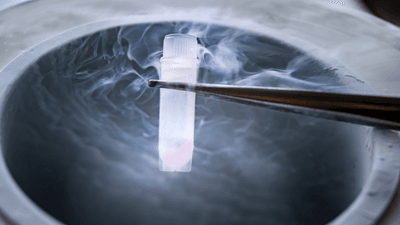


In the quest to live forever, scientists have explored all kinds of unusual avenues. Cryopreservation is a popular talking point, but we humans and our delicate cells don’t deal well with freezing. Being preserved only to turn into gloop isn’t much of a vision for the future, but a new approach has proven it is possible to revive function in brain tissue that’s been preserved in a glass-like state.
This is what’s known as vitrification – an approach to preserving something that replaces water in tissues with chemical solvents that solidify into a glass-like substance rather than freezing in a crystalline structure. This overcomes a critical issue with cryopreservation, which is that crystal formation has the potential to destroy cells, leading to that gloop effect I mentioned earlier when whatever tissue is eventually thawed.
A team of scientists decided to put a new vitrification protocol to the test and see how well it preserved the structure and function of mouse brains. They tinkered with aspects of vitrification that could reduce the risk of tissue swelling, crystallization, and trauma. They then vitrified the brain as a whole, before rewarming it and cutting slices from the hippocampus – an area of the brain associated with memory and learning.
The key point for us was not just that some cells survived, but that the tissue retained core features of function after rewarming, including neuronal excitability, synaptic transmission, and long-term potentiation, which is a central cellular mechanism underlying learning and memory.
Dr Alexander German
The next step was to check if the brain tissue was intact and, if so, there was anything going on. The results showed that – for at least some of the samples – the hippocampal tissue was able to restart electrical information processing. Yep, even after having been preserved in a glass-like state at -196°C (-320.8°F).
“The key point for us was not just that some cells survived, but that the tissue retained core features of function after rewarming, including neuronal excitability, synaptic transmission, and long-term potentiation, which is a central cellular mechanism underlying learning and memory,” said study author Dr Alexander German of Universitätsklinikum Erlangen to IFLScience. “That suggests the relevant neural architecture was preserved well enough for the circuitry to become operational again.”
Not all of the mouse brain samples recovered normal activity after rewarming, but it marks a significant step in establishing if the cellular machinery responsible for learning and memory can survive preservation. So, what’s next?
“Looking ahead, I think the most immediate applications are in research,” said German. “This approach could allow viable neural tissue to be preserved in a near-native state and experiments to be distributed across time and location, which may improve reproducibility and reduce animal use. It could also be useful for structural studies, for example where one wants to preserve tissue for histology or connectomic analysis while maintaining the architecture as faithfully as possible.”
It is the first work to show any recovery of electrophysiological function (e.g. 'brain waves') from a brain that had been vitrified (turned to glass) and then rewarmed.
Dr Ariel Zeleznikow-Johnston
“In the longer term, the broader significance is for cryomedicine. Advances in vitrification could contribute to better preservation of organs and other complex tissues for transplantation and may also open new possibilities for protecting the nervous system in severe injury or disease. That said, there are still important limitations: our current study shows short-term recovery in murine tissue, and substantial technical challenges remain before such methods could be translated to larger organs or clinical settings.”
But what about that goal of living forever? Could a preserved human brain be brought back? As Dr Ariel Zeleznikow-Johnston, neuroscientist and author of The Future Loves You (who was not involved in the study), told IFLScience, it marks an exciting step, but we’ve still got a long way to go.
“Alex German's study is impressive in that it is the first work to show any recovery of electrophysiological function (e.g. 'brain waves') from a brain that had been vitrified (turned to glass) and then rewarmed,” he said. “This had previously been done for thin slices of brain tissue, but not on an entire brain at once.”
“The study itself makes clear that there is a long way from doing this to an entire mouse brain and doing it for a larger mammal (e.g. rat, pig, monkey, human) […] That being said, the study strengthens the case for two things: That brain activity can be at least partially restored after a brain has become completely inactive and solidified. This had previously only been shown for slices, now it's been shown for a whole brain at once
“[And] that it may become possible eventually to develop a protocol that can reversibly place an animal into stasis, where it is vitrified at low temperatures for an indefinite period of time, and then later rewarmed and restored to behavioural function.”
The study is published in the journal PNAS.


