Nature
 PUBLISHED
 11
11


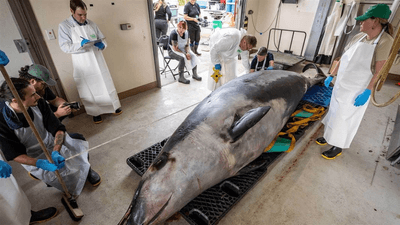


The first-ever dissection of the world’s rarest whale has enabled Indigenous people and conservation scientists in New Zealand to learn more about one of their taoka, which means treasure in the language of South Island Māori culture. The marine mammal was a spade-toothed whale, Mesoplodon traversii, the rarest species of beaked whale with only six specimens confirmed to date, and nobody’s ever seen one alive.
Department of Conservation (DOC) staff turned up to investigate reports of a dead, beached whale near the small fishing village of Taieri Mouth on July 4. When they arrived, they were shocked to find the five-meter (16-foot) male was a spade-toothed whale – “one of the most poorly known large mammalian species of modern times,” said DOC Coastal Otago Operations Manager Gabe Davies in a statement at the time.
Spade-toothed whale dissection
Such a creature washing ashore was a rare and pivotal opportunity to learn more about the species, marking the first time a complete spade-toothed whale specimen had been recovered for examination. Now, the first-ever dissection of a spade-toothed whale has returned some novel insights about their anatomy.
“Not only was this tohorā (whale) the first of its kind to be dissected by science, but it was also the first time our hapū (subtribe) worked with scientists to pull together Indigenous and western knowledge systems so we can all gain a better understanding of the whale and its behaviours,” said Rūnanga member Rachel Wesley in a recent statement on the dissection.
“This process was led by our rakatahi (young people) and guided by our esteemed guests from Ngāti Wai – Hori Parata and his son Te Kaurinui – who are tōhuka (experts) in working with these taoka (treasures). By working with and learning from leaders in te ao Māori, as well as leaders in western science, our rakatahi can revive ancient matauraka (knowledge) and develop an in-depth knowledge system to pass onto the next generations.”
Spade-toothed whale's vestigial teeth
Their work revealed, for the first time, that spade-toothed whales have tiny vestigial teeth in their upper jaw. Vestigial structures like this are considered remnants of evolution, demonstrating that they once served a greater purpose and, while now reduced, there’s not been evolutionary pressure to lose the trait entirely.
The reduced hind limbs of whales are often touted as another example of vestigial structures, left over from their landlubbing days around 50 million years ago. Now, the legs are reduced to tiny hip remnants, but they may still serve a rather steamy purpose.
Spade-toothed whales have nine stomach chambers
Another curious feature of the spade-toothed whale was its many stomach chambers – nine, to be precise – and there were also some clues as to how they eat and communicate.
“In some of those stomachs we found squid beaks and some lenses from the eyes of squid, a few parasitic worms, and maybe some other parts of organisms that we are not quite sure of,” said DOC Marine Science Advisor and beaked whale expert Anton van Helden. “We have a parasitologist who will study them to find out what they are.
“We also found interesting structures associated with both feeding and sound production. Weights and measurements and descriptions were made of various muscles and organs, to help us describe this species and make comparisons with related species. These all add to the body of knowledge we are building.”
The death of a rare animal is a sad day for the species, but it’s hoped by learning more about spade-toothed whales, we may be better equipped to conserve them in the future.
The individual was named Ōnumia by Te Rūnanga o Ōtākou in honor of the area of the same name where the whale was found at the mouth of the Taiari River, reestablishing a traditional practice that bonds them to the environment.