Nature
 PUBLISHED


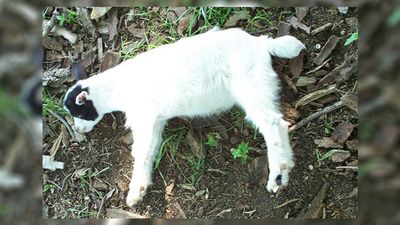


Goats are pretty weird. From the nightmare-fuel Damascus goats to their strange rectangular pupils, it’s no wonder they’re linked to mythical demons like Krampus. But their theatrical flair doesn’t stop with their dramatic visage; one particular breed will stiffen up and faint at even the slightest startle.
These myotonic goats, also known as the Tennessee fainting goat or wooden-leg goat, are an American breed characterized by having the hereditary condition myotonia congenita. This condition is not specific to just goats but can be seen in several different species, including humans. It’s an inherited neuromuscular disorder that affects the electrical processes that regulate muscle contractions, causing muscle stiffness and sudden spasms.
Despite being labeled “fainting” goats, the process behind myotonia congenita actually has nothing to do with losing consciousness. For these goats, their muscles contract and stiffen for around 5-20 seconds when the animal is spooked; however, in humans, the condition doesn’t cause muscle stiffening to occur as a response to fear.
The theory as to why these goats seize up when scared is that a mutation is inhibiting them from receiving muscle-moving chemicals when their “fight or flight” response kicks in, resulting in a secret third option – fight, flight, or fall over.
When an unaffected goat perceives a threat, its brain sends a signal to their muscles, which momentarily tense before releasing and allowing the animal to get away. However, with these goats, their muscles stay tense for far longer than usual, causing them to stiffen and often fall over.
Some goats are affected more severely by the condition than others, and younger goats tend to faint more often than adults. As it’s a recessive gene, the condition is not typically passed on when crossbreeding species.
The rare myotonic goat breed was first recognised in the 1880s by a farm labourer in Tennessee who owned four fainting goats. When these original four were bought and bred, the breed became established. Although little is known about the origins of the initial four goats, the characteristic fainting gene seems not to have arisen anywhere else, suggesting it’s unique to this singular North American breed.
Unlike the sure-footed mountain goat, myotonic goats are known for being lousy climbers, due in no small part to their tendency to stiffen up and fall over at random. This made the breed easy to contain, and so they became a popular source of meat in 1950s Texas.
Today, there are an estimated 3,000 to 5,000 myotonic goats in the US, kept for both meat and as exotic pets. The breeding of this species is tracked and regulated through the International Fainting Goat Association and the Myotonic Goat Registry.
While myotonic goats might look dramatic, their “fainting” isn’t painful and doesn’t negatively affect the goats in any way, so yes, it’s okay to laugh.