Nature
 PUBLISHED


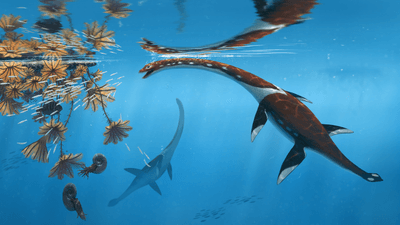


A giant marine reptile that lived during the age of dinosaurs has been discovered in Germany. Retrieved from the world-renowned Posidonia Shale fossil beds, the newly named Plesionectes longicollum has features unlike any other plesiosaur found to date. A new-to-science species, and the first plesiosauroid of its kind.
Its name is derived from the Latin for “long-necked near-swimmer,” giving you a glimpse into what it would’ve looked like when it lived 183 million years ago. Though a new species, the fossil itself was originally excavated in 1978 from a quarry in Holzmaden, Southwest Germany, and it’s been living at the Staatliches Museum für Naturkunde Stuttgart (Stuttgart State Museum of Natural History), where it is cataloged as specimen SMNS 51945, ever since.
"This specimen has been in collections for decades, but previous studies never fully explored its distinctive anatomy," said Sven Sachs of the Naturkunde-Museum Bielefeld, the study's lead author, in a statement. "Our detailed examination revealed an unusual combination of skeletal features that clearly distinguish it from all previously known plesiosaurs."
We’re only just now fully appreciating some of the plesiosaur's unique finer details because this is the first comprehensive scientific analysis of the fossil. With a nearly complete skeleton to play with, the team had plenty to sink their teeth into, including some soft tissues, which is an exceptionally rare find in fossils as old as this one. They included gastralia, a kind of dermal ossification that we see in some species alive today, like crocodiles and tuatara.
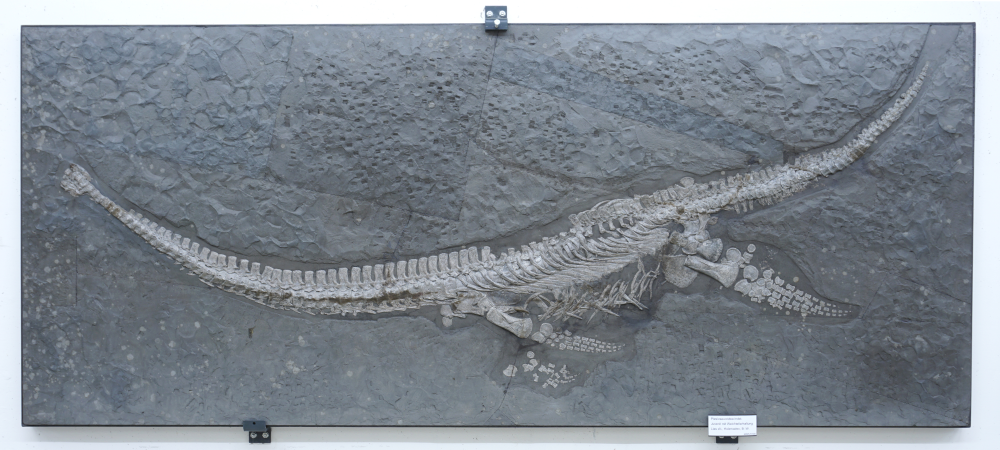
The Plesionectes specimen was an immature individual, though it had already grown to around 3.2 meters (10.5 feet) in length (with 1.25 meters (4.1 feet) of that being its long neck). Fortunately, even at this young age, it exhibited enough distinctive characteristics to warrant its classification as an entirely new genus and species.
"This discovery adds another piece to the puzzle of marine ecosystem evolution during a critical time in Earth's history," explained Dr Daniel Madzia from the Polish Academy of Sciences. "The early Toarcian period when this animal lived was marked by significant environmental changes, including a major oceanic anoxic event that affected marine life worldwide."
It marks the oldest plesiosaur found in the Holzmaden area, a place where five other plesiosaur species have previously been identified. The addition of an extra genus cements the formation's status as one of the world's most important windows into Jurassic marine life, demonstrating that the Posidonia Shale had even greater marine reptile diversity than previously recognized.
The study is published in the journal PeerJ.

 1
1