Space and Physics
 PUBLISHED


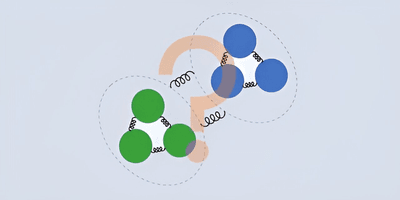


Chinese particle physicists have announced evidence for a new subatomic particle found when the (J/psi) meson decays to a positive and negative pion pair. Although new subatomic particles are found relatively often, and reports of tentative discoveries are more common still, this one stands out because it was predicted more than 70 years ago by the great physicist Enrico Fermi.
Fermi may be best known for the astronomical paradox that bears his name, followed by his role in the Manhattan Project, given renewed attention he might not have welcomed with the Oppenheimer movie. However, his greatest contributions to science were in subatomic physics – including the prediction of the neutrino, once considered fanciful but now key to our understanding of the universe. It seems another of his predictions, of a bound state of a proton and an antiproton, has been vindicated.
Perhaps the most remarkable thing about this prediction is that even the particle whose decay has revealed the suspected product was not thought of during Fermi’s lifetime. It was only a decade after Fermi’s death that the first models of quarks produced the idea of a meson, a type of particle made up of equal numbers of quarks and antiquarks, rather than three quarks as they make up the familiar protons and neutrons.
The (J/psi) meson, also written J/ψ, consists of a charm quark and charm antiquark. Like all mesons, it is unstable and doesn’t last long.
It’s in observing a (J/psi) meson’s decay to positive and negative pions that the BESIII collaboration, composed of representatives from 80 Chinese and Western institutions, found signs of something that matches Fermi’s prediction.
In 2013, the BESIII collaboration found the X(1840) resonance during J/ψ decay. However, on closer examination of 10 billion decays, they found convincing evidence of two resonances close enough together in energy that they were easy to confuse. The new resonance is designated X(1880) with an energy of 1882.1 MeV/c2. This put its mass close to the proton-antiproton mass threshold.
“The proximity of its mass to the ppbar mass threshold supported the existence of a ppbar bound state,” the authors say in a statement. Protons are symbolized in particle physics by p, while pbar is the antimatter counterpart of a proton. A bound state is something composed of two particles that behaves like a single entity.
Improbable as the idea sounds, protons and antiprotons are already known to exist in protonium, where the two orbit their common center of mass for about a millionth of a second before annihilating each other. The new discovery suggests other bound states are possible.
The process was initiated by smashing together electrons and positrons (the antimatter equivalents of electrons) at high energy and watching the tracks of the particle products and photons produced.
The study is published open access in the journal Physical Review Letters.