Nature
 PUBLISHED


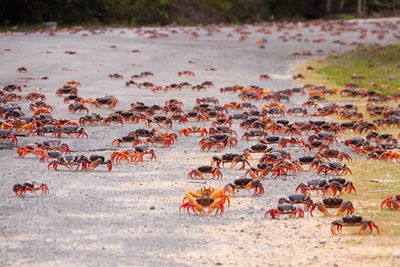


It is a truth universally acknowledged that everything eventually evolves into a crab. Not quite everything, of course, but crab-like forms do appear suspiciously often in the animal kingdom, suggesting that natural selection has some preference for crabby configurations. Strangely, though, their iconic sideways scuttle only evolved once.
Carcinization is the idea that the crab-like body plan has emerged in animals many times through convergent evolution, where similar features independently arise in species that aren't closely related. The word was first coined by English zoologist Lancelot Alexander Borradaile in 1916 who defined it as "one of the many attempts of nature to evolve a crab". Since these early musings, it has gone on to receive a fair amount of scientific study, not to mention plenty of memes.
It's estimated that crustaceans have developed this crabby appearance at least five times in the record of livings things. One of the clearest examples is the Anomura, also known as false crabs, with an ancestor that looked more like a lanky lobster but over time became flatter, broader, and crabbier. Even outside the underwater world of crustaceans, the same blueprint has popped up, as seen with crab spiders (Thomisidae) and pubic lice (better known as crabs).
Put simply, the crab body plan seems to be a very effective blueprint. Its broad, flattened body acts like a fortress-like tank against predators, while also allowing it to scuttle quickly under rocks and into tight crevices. Its pair of powerful claws can catch prey, fend off attackers, or simply anchor it in place, while its spindly legs can move briskly and nimbly.
However, not every part of this tried-and-tested body plan has evolved repeatedly. In a new study, Japanese scientists at Nagasaki University have shown that the iconic sideways scuttle only evolved once, most likely from a single common ancestor that lived around 200 million years ago.
“This single event contrasts starkly with carcinisation, which has occurred repeatedly across decapod species,” Yuuki Kawabata, senior corresponding author from Nagasaki University in Japan, said in a statement. “This highlights that while body shapes may converge multiple times, behavioural changes such as sideways walking can be rare.”
To reach their conclusion, Kawabata and the team recorded the movements of 50 different true crab species and cross-referenced this with genetic data on 344 crustacean species. Of the 50 crabs studied, 35 were sideways walkers and 15 forward walkers. Their analysis showed that horizontal locomotion evolved just once from a single forward-walking ancestor at the root of Eubrachyura, a group comprising more advanced crab species, then has remained largely unchanged ever since.
Why lateral movement evolved only once in true crabs, then apparently never again, remains a bit of a mystery. The researchers suggest it may have proven to be a surprisingly efficient strategy for escaping predators, bamboozling attackers with an unexpected movement.
To find out, the team plans to dive deeper into their genetics.
“These current results highlight that sideways locomotion in true crabs is a rare but innovative trait that may have contributed to their ecological success,” Kawabata concluded. “Such innovations can open new adaptive opportunities and yet remain constrained by phylogenetic history and ecological contexts. With direct behavioural observations and a phylogenetic framework, this work expands our understanding of how modes of travel in animals diversify and persist through evolutionary time.”
The study is published as a “Reviewed Preprint” in the journal eLife.