Nature
 PUBLISHED


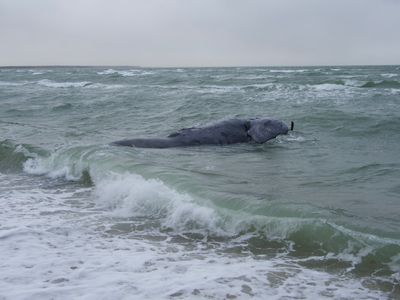


A female North Atlantic right whale has been found dead off the coast of Martha’s Vineyard, Massachusetts, with a rope wrapped around it, the National Oceanic and Atmospheric Administration (NOAA) announced on Sunday.
“On the afternoon of January 28, 2024, NOAA Fisheries was notified of a deceased female North Atlantic right whale near Joseph Sylvia State Beach,” reads a statement. The whale, they add, is thought to be a juvenile and was found with a piece of rope entangled around and embedded in its peduncle – the area where the tail fluke connects to the body.

North Atlantic right whales are one of the most endangered of all large whale species. By the early 1890s, they had been hunted to the brink of extinction and their population has never recovered to pre-whaling numbers. Although they no longer face the perils of whaling, humans still represent their biggest threat, namely because of vessel strikes and encounters with fishing gear. According to NOAA Fisheries, only around 360 individuals remain, including fewer than 70 reproductively active females.
“It’s devastating to hear about another loss to North Atlantic right whales,” Gib Brogan, a campaign director at Oceana, an international conservation group based in Washington, told The New York Times. “This death is even more troubling when it is a female calf that could have gone on to have many calves of her own for decades to come.”
The whale’s cause of death is not currently known, but experts are examining the rope and planning a necropsy (animal autopsy) to hopefully find some clues, NOAA said. Becoming ensnared in a rope in such a way can have a detrimental effect on a whale’s swimming, feeding, and reproduction, and could also lead to flesh wounds and, therefore, potentially life-threatening infections, according to Oceana.

This is the latest in a string of whale deaths and injuries off the US coast and comes during the right whale’s calving season, which runs from November to April.
Since 2017, there has been an ongoing Unusual Mortality Event for North Atlantic right whales, and this whale is the 37th documented mortality. In that same period, 35 whales have also been found seriously injured, and 51 sublethally injured or ill.
On a more positive note, NOAA Fisheries have been making comprehensive efforts to help protect these endangered whales, by addressing the threats they face and monitoring their progress, as described in their "Road to Recovery" for North Atlantic right whales.