Nature
 PUBLISHED
 1
1




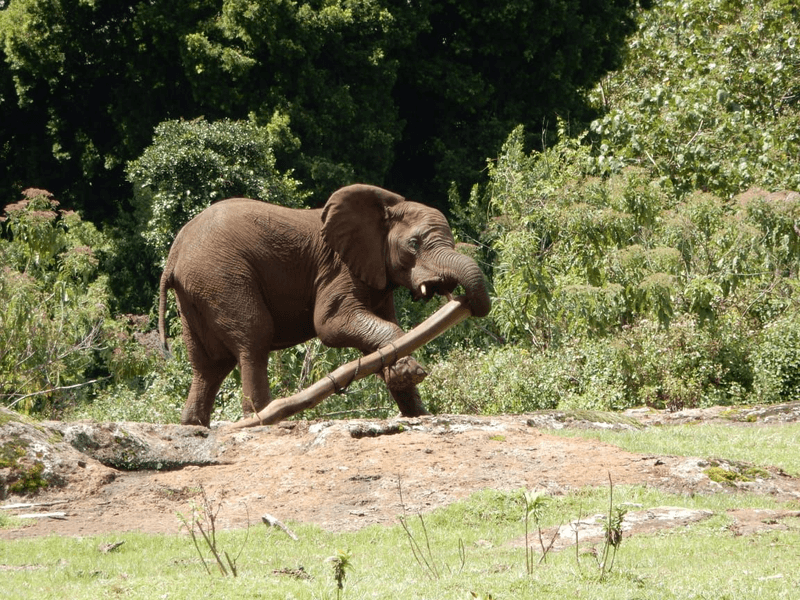
Did you know that elephants walk around on their tippy-toes? It’s strange to imagine, given the sheer size of these animals, but it’s something we learned from looking at a whole load of frozen elephant feet.
That unusual collection belonged to Professor of Evolutionary Biomechanics John Hutchinson. In 2011, Hutchinson and colleagues described a surprising feature of the elephant foot that had been overlooked for hundreds of years.
Much like how the panda’s “thumb” is actually a sesamoid bone that’s been evolutionarily repurposed to act like an extra digit, elephants also have a kind of sixth toe. These enlarged bones sit within the soft pads of both the front and back feet.
Although these structures start out as cartilage, they partly harden into bone and function much like true digits. Fossils preserve clear evidence of these features and how they connect to the wrist and ankle bones, allowing researchers to track when they appeared. They’ve revealed how earlier relatives of elephants had very different feet.
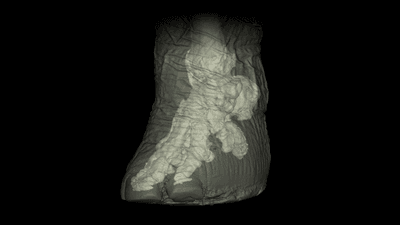
There was a time when elephants and their ancestors were flat-footed, but over time they shifted towards the tip-toed walking style seen in modern elephants. Inside their feet today is a thick, springy pad beneath the heel that effectively lifts the back of the foot. This is why, on CT scans (like the one at the top of this article), it looks a bit like they’re wearing in-built high heels.
The addition of this sixth digit helps support their enormous weight – an adaptation that likely unfolded in tandem with changes in habitat and body size among modern elephants’ ancestors.
“These changes occurred while early elephantiforms attained gigantism (>2000 kg of body mass or shoulder height >2 m) in the Eocene epoch (~40 million years ago) and occupied a wider range of terrestrial habitats, becoming less amphibious around the node joining Deinotheriinae and Elephantiformes,” write Hutchinson and colleagues in their 2011 study.
“Hence, there is probably a link between the increasing demands of supporting and moving greater weight on land and the benefits of having more upright toe bones but directing some loads away from the toes with the predigits and fat pad, which resulted in the peculiar compromise that persists in the feet of extant elephants.”
This evolutionary solution allows elephants to support their massive bodies while minimizing damaging pressure as they walk. Foot health is critical for elephants, not only for movement but also for communication. These animals use low-frequency vibrations known as infrasound – too deep for humans to hear – that can travel long distances and are partly detected through their feet.
So, why choose fashion over function when you can have it all?