Space and Physics
 PUBLISHED


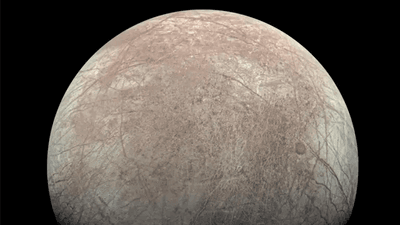


A new paper has suggested that life may be trapped in a subsurface ocean on Jupiter's moon Europa, and Earth itself may have sent it there.
There are a few ideas about how life began on Earth, with the most favored in recent years being that it emerged in hydrothermal vents in the oceans billions of years in the past. But not all hypotheses have Earth as the absolute origin of life. One idea – known as panspermia – is that life could have been carried across the Solar System, or perhaps even the galaxy, before eventually being delivered to our planet.
It is well understood that asteroids and comets contain the so-called "ingredients" or "building blocks" necessary for life, and that they occasionally deliver these ingredients to a larger planetary body via the old Deep Impact method. The hypothesis of panspermia goes one step further (but it is quite a large step), suggesting that entire microbes could be carried on asteroids, comets, or cosmic dust and delivered around the cosmos via these means.
Unless we happen upon a meteorite rammed full of alien microbes, that is going to be very difficult to confirm or rule out. But we can, for example, try to figure out how likely it is that microbes could survive for long time periods in space or attempt to calculate how far asteroids, comets, and dust grains spread throughout the Solar System and the wider cosmos.
In a new paper, Zaza Osmanov of the Free University of Tbilisi in Georgia took an interesting approach to the problem. Osmanov attempted to calculate how much dust and bacteria Earth could have sent out into the Solar System, and how much it may have sent Europa's way.
Previous research has shown that dust grains at high altitudes in Earth's atmosphere could gain escape velocity by colliding with cosmic dust particles, starting their journey across the cosmos. This paper takes that idea and asks, if that is the case, is it plausible that Earth has been seeding other worlds?
"Life on Earth originated at least 3.55 billion years ago, which implies that for approximately that long, Earth has been shedding life-bearing particles into surrounding space," Osmanov writes in the new paper. "Hence, if favorable conditions exist elsewhere in the Solar System and can be accessed by dust particles, the transport of life from Earth appears plausible and may have been occurring over the course of several billion years."
Europa, it should be noted, wasn't chosen at random but because of its potential for hosting life in its subsurface oceans. The paper attempted to investigate whether Earth could have sent dust, and ultimately bacteria, to its surface during Earth's "life" phase.
Osmanov attempted to constrain his calculations to dust grains large enough to contain bacteria and collisions that wouldn't result in the bacteria getting cooked (at around 300 K). Then he did a lot of math. Osmanov tried to estimate the amount of dust that would leave Earth, as well as the amount that would make it to the Jupiter system and eventually fall down on Europa. In addition, the paper considers the type of impact that would produce these dust grains, again estimating how likely they are to occur.
While there are many assumptions in the paper, and it is clearly quite a broad estimate, Osmanov is heavily in the "Earth could have plausibly seeded life on Europa" camp.
"Recent studies show that the age of Europa’s icy surface is at least 30 − 80 Myr," the paper explains. "Therefore, the total number of particles during the mentioned period is of the order of (3−8) × 1023, which strongly suggests the likelihood of life being present in the subsurface ocean of Europa if the biological and biochemical conditions are compatible with Earth-originating life, which would require a new series of investigations to determine."
While galactic-reaching panspermia may require a little more in the way of evidence for the very very, very very, very long-term survival of bacteria, more local panspermia may not be too far out of the realm of possibility.
“I think there's good evidence,” Ben Weiss, a professor of planetary science at MIT, told IFLScience of the idea of panspermia in general.
“It's certainly not a crackpot idea to suggest that within our own Solar System that some of the planets are not biologically isolated. We are confident that probably billions of tons of Martian rocks have been transferred to Earth since the two planets formed. We also know that every few hundred thousand years, a fist-sized rock gets from Mars [to Earth] in just a year.”
The study is published in the International Journal of Astrobiology.