Space and Physics
 PUBLISHED
 1
1


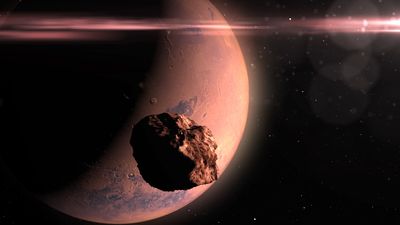


For humans, it is very difficult to leave Earth. You need powerful rockets and spacecraft that maintain the very narrow set of conditions in which we can be alive. For bacteria, this might be different. Sure, microbes have not developed rocket science, but new evidence suggests that they might not need it to travel across interplanetary distances. They just have to be sturdy and wait for an asteroid impact.
The idea of bacteria spreading through the Solar System using asteroids is not new, but new research has provided crucial insights into the ability of a certain extremophile bacterium – Deinococcus radiodurans – to withstand high pressure, similar to what would happen in a real asteroid impact.
“We wanted to see whether life could survive planetary-scale impacts, specifically the dynamically applied high pressures associated with these large impacts,” lead author Lily Zhao from Johns Hopkins University told IFLScience. “So we shot some extremophiles to see if they survive. We saw that they did at an incredibly high rate… that has not been observed in literature before.”
The team picked an extremophile from the Chilean high desert that has the ability to survive some of the most inhospitable conditions on Earth: extreme cold, dryness, and intense radiation. These are conditions that are baseline on Mars, even though Earth at its most extreme is still paradise compared to the Red Planet.
That said, the pressure experienced by the microbe was tens of times that which exists at the bottom of the Mariana Trench. There, it is about 0.1 gigapascal. At 1.4 gigapascals, the bacteria survived nearly every test with no damage to the cells. At 2.4 gigapascals, about 60 percent survived, although with some membrane rupturing and internal damage.
It's really remarkable how nature has adapted itself to these conditions.
K.T. Ramesh
“When we started out, we were interested in what the limits of life are,” senior author K.T. Ramesh, also at John Hopkins, told IFLScience. “How far can they go in terms of surviving these extreme mechanical stresses?”
The team focused in particular on Mars-like conditions, hence the choice of that specific extremophile. However, the findings are more universal – impacts on Earth might have thrown asteroids with microbial astronauts across the Solar System. While it is easier for space rocks to go towards the inner Solar System over time, it is possible that things traveled far out. Life might have spread from Earth or started elsewhere before getting here.
The team is now investigating other bacteria to see how they fare.
“We are realizing that these organisms are much hardier than we thought,” Ramesh continued. “Every time we look at a new extreme condition: you start with cold, you look at desiccation, you look at radiation, you look at high temperature, you look at high pressure. Now, you look at dynamic high pressure.”
“In every case, we found organisms that survived. It's really remarkable how nature has adapted itself to these conditions. We just think that tells us that life is much more resilient than we thought!”
We asked Zhao for a final message about this work, and she said: “This research is cool and the public should be interested in it!” And we wholeheartedly agree.
The study is published in the journal PNAS Nexus.