Nature
 PUBLISHED


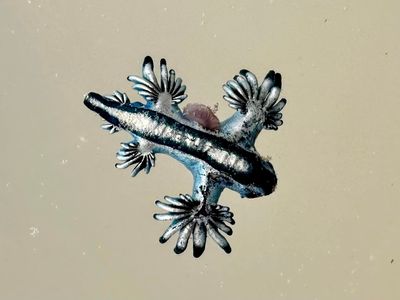


Species within ecosystems are intrinsically linked. Whether they time the birth of their offspring with the sea ice or have evolved to live aboard another organism, these connections can be found time and time again in nature. Now, on a beach on North Padre Island off the coast of Texas, yet another example has appeared in the form of tiny blue dragons, and experts are warning people not to touch them.
These blue dragons are also known as blue glaucus (Glaucus atlanticus), a sea slug and a species of nudibranch that lives in the open ocean. While they might look impressive – and indeed they are – these are tiny dragons, rarely measuring more than 3 centimeters long (1.2 inches). However, don't be fooled, they have a sting stronger than a Portuguese man o’ war.
The Harte Research Institute for Gulf Of Mexico Studies shared images on their Facebook page this week of both man o' wars and blue dragons that had blown onto the beach on North Padre Island in strong winds. The Institute called this arrival the “blue wave” and expects more such discoveries as the weather changes.
These bright blue creatures can be found on the surface of the Atlantic, Pacific, and Indian Oceans in temperate waters, and have even been seen swimming in the Great Pacific Garbage Patch. The tiny critters use special sacs on their stomachs to hold air to keep themselves afloat.
While they might be small they do have a few tricks up their tiny sleeves. The nudibranchs feed on the Portuguese man o’ war. While the venom of this species is excruciatingly painful, according to NOAA it is rarely deadly. But unlike humans, the blue dragons are immune to the toxins within the man o' war. Instead, the blue glaucus can siphon off the stinging cells from the siphonophore, which are called nematocysts, and store them itself within the frilly ends of its body.
The blue glaucus is capable of holding so many of these stinging cells within that when touched by a human or predator, the dragons release stinging cells full of these toxins into their attacker, making them even more dangerous than the man o’ war itself.
Even more extraordinarily, the blue glaucus is a simultaneous hermaphrodite, possessing both male and female reproductive organs. According to Oceana, 16 eggs are laid, which take roughly three days to hatch and then live around a year.
They may be beautiful and, as they are tiny, you may want to get up close and personal to take a picture if you come across one, just remember: don't touch!


 1
1