Nature
 PUBLISHED
 5
5


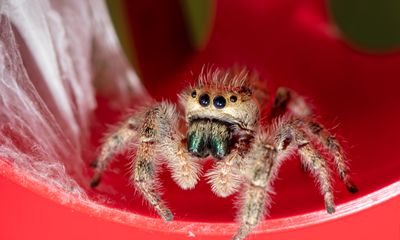


Yes, spiders do sleep (or at least enter a sleep-like state that's very similar to our form of slumber).
Much like us, spiders need a deep rest state to keep their brains functioning and their bodies healthy. Given the vast differences in brain structure and evolutionary history between humans and arachnids, it’s no shocker to hear there are some big differences in our states of snooze – although there are some truly remarkable similarities.
In biological terms, sleep is a reversible state of reduced responsiveness to external stimuli and decreased physical activity, accompanied by certain neurological and physiological changes.
Some species of spider can remain motionless for long periods of time while they are waiting for unwitting prey to land in their web, although they’re not napping in this static state. Quite the opposite; they're poised and ready, waiting like a coiled spring.
However, scientists can tell when a spider has entered a sleep-like state because they nestle their bodies into a “stupor” position.
“We can go out at night – or during the day, depending on the type of critter that we’re looking at – and we can find them when they’re in some type of stupor condition. So maybe there are a bunch of them sitting on a plant, and they’re not moving,” Richard Zack, an entomology professor at Washington State University, told Ask Dr. Universe, a science education project based at the college.
Certain species might have even stranger sleep states. A study in 2021 looked at European jumping spiders (Evarcha arcuata) and found they rest at night by suspending themselves from a single silk thread.
Some researchers prefer to call this kind of action a “sleep-like state” or a “nocturnal resting behavior” when it's observed in other animals, especially invertebrates that have very different brain structures to us.
Perhaps these distinctions are not necessary, though. When scientists took a closer look at the resting behavior of jumping spiders, they uncovered some strange similarities with the sleep of humans and other animals.
The sleep of mammals and birds goes through two main phases: non-rapid eye movement (NREM) and rapid eye movement (REM) sleep. In the deepest NREM stage, the body undergoes processes of physical repair, cellular recovery, and energy restoration, along with “slow” brain waves. Conversely, REM sleep is marked by faster brain activity similar to wakefulness, vivid dreams, and the flickering of eyes under the eyelids (hence its name).
Despite having eight eyes, jumping spiders do not have eyelids, which makes it difficult to make cross-species comparisons. However, they possess movable retinal tubes to redirect their gaze. Since juvenile spiders have translucent exoskeletons, it’s possible to see the movement of these eye structures.
A 2022 study investigated this and found that the jumping spiders appear to go into “a REM sleep-like state.” While in this sedentary state, the spiders also jerk around their limbs, a bit like a dog twitching its legs when it dreams.
This led the researchers to speculate that the jumping spiders may be dreaming, just like we do.
“Personally, after watching hundreds of spiders, there is no doubt in my mind that they experience dreams, just like no one would doubt that when watching a cat or a dog dream," Daniela Rößler, lead study author from the Max Planck Institute of Animal Behavior, told IFLScience in 2022.
"Whether we will be able to scientifically prove that this is the case… we will have to see," she added.