Nature
 PUBLISHED


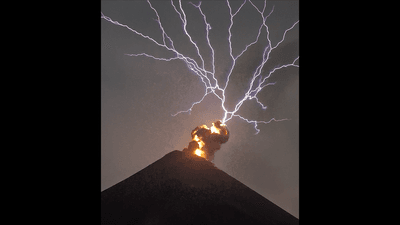


Thunderstorms and volcanic eruptions are some of Earth’s most powerful natural phenomena. Combine the two and the result is truly dazzling. Onlookers at Volcán de Fuego in Guatemala were wowed to see lighting seemingly strike the edge of the erupting crater earlier this month.
Volcán de Fuego, a 3,763-meter (12,346-foot) tall stratovolcano, is Guatemala's most active volcano and one of the most active in South America. The volcano has been erupting with regularity since 2002, and even has recorded eruptions dating back as far as 1531 CE.
Reports of its activity indicate that it emits gas and ash into the air as often as multiple times a day, with an uptick in frequency after a significant eruption in June 2018, which caused the loss of 190 lives and the destruction of many homes and nearby infrastructure.
Johan Wolterink filmed a lightning bolt striking the volcano’s crater on Sunday, April 28 of this year, as a thunderstorm occurred at the same time as the eruptions. He shared the video on social media with the caption: “What are the odds?”
What Wolterink and his fellow observers saw was what's been dubbed a “dirty thunderstorm”, a nickname given to the lightning generated by the volcanic eruption itself rather than as a consequence of a typical thunderstorm. This is caused by the ash particles colliding with each other, producing static electricity.

 1
1