Nature
 PUBLISHED
 3
3


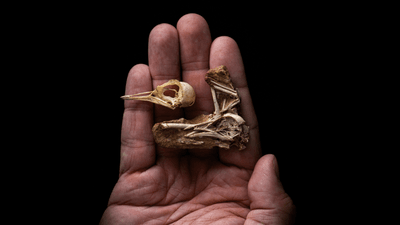


An almost perfect intermediate between Archaeopteryx and modern birds has been discovered with its skull preserved in extraordinary three-dimension. To find such an intact fossil bird that dates back to the Mesozoic is almost unheard of, making the find one of the most significant of its kind, but that’s not all.
The dinosaur-era bird is about the size of a starling, and is being described as a Rossetta Stone for working out how and when the bird brain evolved into the incredibly intelligent processing machine it is today. By recreating its brain, scientists were able to establish that its enlarged cerebrum suggests it was more intelligent than the earliest bird-like dinosaurs, but that it lacked the developed cerebellum seen in modern birds, which is associated with complex flight control.
"Birdbrain" used to be a solid insult for when you wanted to imply someone was stupid, but if you use it nowadays, you’re going to look like the birdbrain. That’s because we’ve come to realize that despite its small size, the bird brain can be stuffed full of neurons, and some species exhibit advanced intelligence as a result. Just look at the grudge masters of the sky, crows.
However, science has been grappling with a 70-million-year gap in the story of how avian intelligence evolved, because finding well-preserved fossils that reveal clues about the brain hasn’t been easy. Now, the discovery of a bird that’s been named Navaornis hestiae could change all that, as despite having died around 80 million years ago, its fossil skull is almost intact.

“This fossil is truly so one-of-a-kind that I was awestruck from the moment I first saw it to the moment I finished assembling all the skull bones and the brain, which lets us fully appreciate the anatomy of this early bird,” said co-lead author Dr Guillermo Navalón from Cambridge’s Department of Earth Sciences in a statement. “The brain structure of Navaornis is almost exactly intermediate between Archaeopteryx and modern birds – it was one of these moments in which the missing piece fits absolutely perfectly.”
“This represents nearly 70 million years of avian evolution in which all the major lineages of Mesozoic birds originated – including the first representatives of the birds that live today. Navaornis sits right in the middle of this 70-million-year gap and informs us about what happened between these two evolutionary points.”
Its near-perfect preservation enabled the team to recreate its brain using advanced micro-CT scanning. The resulting image looked a bit like a pigeon’s brain at first, but they soon realized the brain didn’t belong to a modern bird, but instead an enantiornithine, a group that diverged from modern birds over 130 million years ago. They too had complex feathers and could fly, but evidently they lacked the expanded cerebellum associated with advanced spatial control.
“This fossil represents a species at the midpoint along the evolutionary journey of bird cognition,” added Professor Daniel Field from Cambridge’s Department of Earth Sciences, senior author of the research. “Its cognitive abilities may have given Navaornis an advantage when it came to finding food or shelter, and it may have been capable of elaborate mating displays or other complex social behaviour.”
“Modern birds have some of the most advanced cognitive capabilities in the animal kingdom, comparable only with mammals. But scientists have struggled to understand how and when the unique brains and remarkable intelligence of birds evolved – the field has been awaiting the discovery of a fossil exactly like this one.”
Congratulations, bird brains. Vindication at last.
The study is published in the journal Nature.