Humans
 PUBLISHED
 2
2


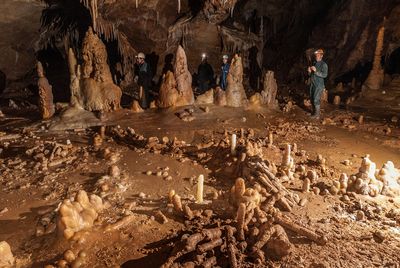


Might this be the oldest surviving structure in the world? It could very well be, but it wasn’t crafted by the hands of modern Homo sapiens.
The mystery of Bruniquel Cave
To find it, archaeologists had to tread carefully for 336 meters (1,102 feet) into the dank Bruniquel Cave, located in a picturesque pocket of southwestern France, not far from Toulouse.
Once they reached its largest chamber, they were confronted with two structures made from stalagmites that had been yanked from the cavern floor, broken into bits, and placed in a circular formation.
The stalagmites appear to have been intentionally broken into pieces so they measure the same size, roughly 30 centimeters (~12 inches) in length. Most of the fragments also show evidence of burning, with the calcite discolored black and red, suggesting they were intentionally subjected to fire as part of a deliberate process. The purpose of this treatment remains unclear.
One of the rocky rings measures 6.7 by 4.5 meters (22 by 14.8 feet) in diameter, while the other is 2.2 by 2.1 meters (7.2 by 6.9 feet).
In total, 400 pieces were used, adding up to a total length of 112.4 meters (368.8 feet) and some 2.2 tons of calcite.
Who created the structures of Bruniquel Cave?
Based on the neat, geometric shape of the circles, as well as the presence of burnt bones, researchers have concluded it must have been actively created by humans of some description. The identity of the creator, however, has been under some dispute.
When it was first studied by archaeologists in the 1990s, a fragment of burnt bone suggested it was dated to around 47,600 years old. However, in 2016, another team of researchers took a fresh look at the cave using uranium-series dating.
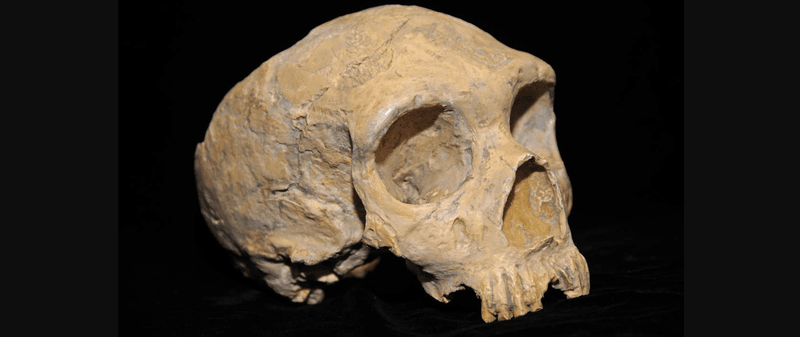
The more recent dating suggested the structure was made some 176,500 years ago. Since this is long before Homo sapiens arrived in Europe, this firmly placed the work as the responsibility of Neanderthals.
An "unprecedented" site
Some researchers speculated whether the stalagmite structures acted as a kind of shelter, since this was a time when glaciers and harsh conditions dominated this part of the planet. Others suggested they might represent some kind of ritual behavior, like an early temple, or a domestic site with a clear practical function.
Whatever its purpose, the structure reaffirms the idea that our Neanderthal cousins weren’t as bone-headed as sometimes suggested. Constructing these circles would have required planning, cooperation, and foresight, all complex qualities that require a fair amount of cognitive power.
“The attribution of the Bruniquel constructions to early Neanderthals is unprecedented in two ways. First, it reveals the appropriation of a deep karst space (including lighting) by a pre-modern human species,” Jacques Jaubert and his co-authors, who dated the site in 2016, wrote in their paper.
“Second, it concerns elaborate constructions that have never been reported before, made with hundreds of partially calibrated, broken stalagmites (speleofacts) that appear to have been deliberately moved and placed in their current locations, along with the presence of several intentionally heated zones,” they continued.
“Our results therefore suggest that the Neanderthal group responsible for these constructions had a level of social organization that was more complex than previously thought for this hominid species.”
Caves, caves, caves
Caves are where archaeologists gather much of what we know about Neanderthals. This isn’t because they solely lived in caverns, but they do a great job of preserving their remains and the stuff they left behind.
From this picture, we also see that Neanderthals had something of a penchant for stalagmites. Caves in the south of Spain contain stalagmites that have been painted by Neanderthals around 65,000 years ago, making it some of the earliest cave art on record.