Humans
 PUBLISHED


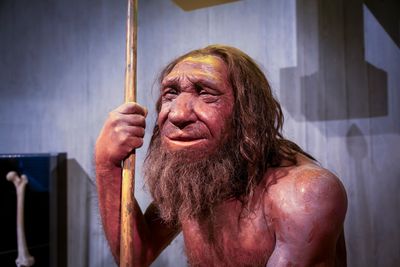


Neanderthals had a PR disaster in the century after their discovery in 1856. Up until fairly recently, they were dismissed as heavy-browed, hairy "cavemen" in the popular imagination. Many blame this unfortunate stereotype on one man, Marcellin Boule, and his misinterpretation of a single Neanderthal skeleton, known as "the Old Man of La Chapelle". However, the story is a little more complicated than that.
In 1908, Boule embarked on a lengthy study of a hominin skeleton – named "La Chapelle-aux-Saints 1" – recently discovered within a cave in central France. As the first detailed analysis of an entire Neanderthal skeleton, the paper made a big splash in the burgeoning world of anthropology, which had only just begun to grapple with the uncomfortable truth that Homo sapiens was not the first and only human species to ever walk this planet.
However, Boule was not exactly impressed by the new species, nor struck by its similarities with our own. Far from any sense of awe, his characterization of the prehistoric skeleton attempted to put a gulf of distance between the Neanderthal and modern humanity. He suggested the Neanderthal was "uncouth" and "repellent," possessing a primitive and "heavy body" that was echoed in its "rudimentary and most miserable" technology.
"The Neanderthal Man must have possessed only a rudimentary psychic nature, superior certainly to that of the apes, but markedly inferior to that of any modern race whatever," Boule wrote in his 1923 book Fossil Men: Elements of Human Palaeontology.
"Even the primitives at the peripheries of the Earth are considerably more advanced than this brute, which is closer to the apes than any human race," he added in his 1908 study.
We now know that this interpretation is highly inaccurate (if not a little rude). When researchers analyzed La Chapelle-aux-Saints 1 in 1956, they found that its hunched posture was almost certainly the result of severe osteoarthritis, not some innate "ape-like" stature. His missing teeth, they concluded, were not a sign of primitive neglect but rather evidence that other individuals had cared for him during diminishing health, keeping him alive through altruism and compassion.
Although the prehistoric skeleton was in remarkably good condition, Chapelle-aux-Saints 1 proved to be a deeply unrepresentative member of the species; it would be like making an elderly, disabled man the archetypal image for all Homo sapiens.
The misinterpretation is sometimes called "Boule's error". His extensive writing, accompanied with some unflattering illustrations, had long been blamed for the negative stereotype of Neanderthals that persisted throughout the 20th century and continues to linger today.
However, this bad reputation might not have been purely Boule’s fault. Revisionists have once again looked through the historical narratives of the 19th century and found that the "brutish" reputation of Neanderthals started way before the La Chapelle-aux-Saints 1 left his cave.
"Boule interpreted the elderly, arthritic skeleton as an idiotic hunched-over brute—conflating pathological deformity with species-wide idiocy. This mistake, scholars have argued, resulted in a ‘merciless characterization’ of the species that ‘almost single-handedly’ revolutionized the ways scientists think about Neanderthals," Paige Madison, a science writer and historian of palaeoanthropology, wrote in a 2020 paper published in the Journal of the History of Biology.
Madison goes on to argue that the Neanderthal’s reputation of being an "uncouth and repellent creature" actually started in the 19th century, decades before Boule’s work hit the press. While he did reinforce the myth, he can't be held solely responsible for its spread.
The 19th century and early 20th century was an era when emerging theories of race were intertwined with a worldview that believed in the unstoppable force of progress. Humans, they thought, must have started as idiotic apes, advanced into slightly less idiotic apes, before eventually transforming into God’s masterpiece: Homo sapiens (which means "thinking man" in Latin).
However, this image of linear, progressive evolution is a very flattened view of the truth. In reality, it is simply the unglamorous, achingly long process of organisms fitting themselves to the world around them. There is no ladder, no finishing line, and no hierarchy.
Even more research work has only affirmed this idea and helped to resurrect the image of the Neanderthal. In the 21st century, we now know they made complex tools and liked to adorn their caves with artworks. Many researchers believe they buried their dead with intent in what looks, to our eyes at least, something like grief and an understanding of mortality. Perhaps some Neanderthal communities even had something akin to religion or spirituality.
So the next time you hear someone throw around the word "Neanderthal" as an insult, remember it really isn't the put-down they think it is.