Nature
 PUBLISHED
 2
2


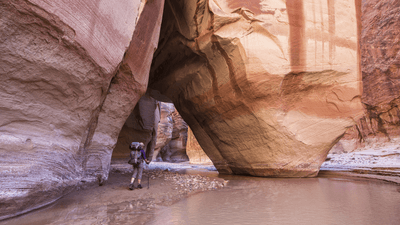


Three hikers were recently caught in a flash flood while hiking the Buckskin Gulch slot canyon in southern Utah. The men in their 50s were experienced hikers, but the severity of the conditions meant that only one was found alive after they were reported missing.
Buckskin Gulch in Utah is the longest and deepest slot canyon in the southwest, stretching across 25.7 kilometers (16 miles) of southern Utah towards Arizona, making it a popular choice for keen hikers. Unfortunately, the topography of the land also means it can become extremely dangerous for people who get caught out in the canyon in bad weather.
The hikers began their journey on Friday, but when they didn’t return a search and a rescue party were sent out on Monday. Two of the men were found dead and a third was rescued. Shockingly, while pursuing a tip one of the bodies was found around 4.8 kilometers (3 miles) past the Utah-Arizona state line.
“It will forever be a mystery to us how he got that far downstream,” Lt. Alan Alldredge, an emergency services official and spokesman for the Kane County Sheriff’s Office, told the New York Times. “We will never know.”
CNN meteorologist Robert Shackleford has suggested the flash floods may be linked to an atmospheric river that recently struck parts of the US. Atmospheric rivers are slender, transient columns of condensed water vapor that travel in the atmosphere – “like rivers in the sky,” according to the National Oceanic and Atmospheric Administration (NOAA). When the “river” makes it to land, it’s usually in the form of heavy rain or snowfall.

In 2021, it was discovered they can also form atmospheric lakes: a massive aggregation of water vapor in the atmosphere, which is slow-moving and can endure for days. They form when atmospheric rivers pinch off and slow, forming a “lake” that can hold – and eventually rain – an awful lot of water.
Atmospheric rivers have been linked to slowing sea ice recovery, and ongoing research suggests they may become increasingly common under the climate crisis. With the capacity to cause destructive and potentially fatal weather conditions, a new system for categorizing their severity like hurricanes was recently released.
The intensity scale ranks from AR-1 to AR-5, with 5 being the most severe, as a way of measuring their duration and the volume of water they’re carrying.
“[Atmospheric river] is no longer an obscure meteorological term but brings sharply to mind unending rain and dangerous flooding,” Science Daily explains. “The string of atmospheric rivers that hit California in December and January, for instance, at times reached AR-4. Earlier in 2022, the atmospheric river that contributed to disastrous flooding in Pakistan was an AR-5, the most damaging, most intense atmospheric river rating.”
Active advisory is now in place, requesting that people stay away from the area while severe and unpredictable flash flooding continues. For further advice visit the Bureau Of Land Management’s website.