Nature
 PUBLISHED
 1
1


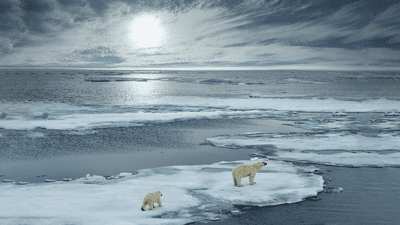


Sea ice loss in the Arctic may be being made worse by powerful storms capable of shifting vast quantities of water through the air as vapor. Known as atmospheric rivers, they’re increasingly reaching the Arctic even in the freezing winter months when the sea ice is normally given a chance to recover from its summer melt. However, it looks as if atmospheric rivers are now getting in the way of this recovery.
“Arctic sea ice decline is among the most obvious evidence of global warming from the past several decades,” said lead author on a new study Pengfei Zhang, assistant research professor of meteorology and atmospheric science at Penn State, in a statement.
“Despite temperatures in the Arctic being well below freezing, sea ice decline in winter is still very significant. And our research shows atmospheric rivers are one factor in understanding why.”
An atmospheric river is a slender, transient column of condensed water vapor from the tropics located up in the atmosphere – “like a river in the sky,” according to the National Oceanic and Atmospheric Administration (NOAA). When the “river” makes it to land, it’s usually in the form of heavy rain or snowfall. Such storms recently brought 11 inches of rain to California and frequently impact midaltitude coastal regions.
In 2021, we discovered they can also form atmospheric lakes: a massive aggregation of water vapor in the atmosphere, which is slow-moving and can endure for days. They form when atmospheric rivers pinch off and slow, forming a “lake” that can hold and eventually rain an awful lot of water.
Now, scientists have combined satellite observations with climate simulations to investigate how atmospheric rivers impact the Arctic during what would normally be the ice-growing season. They observed that after an atmospheric river meandered into the region, there would be an immediate effect on sea ice, which began to retreat and continued to do so for 10 days after the storm.
The finding is even more worrying in the context that atmospheric rivers are becoming more frequent in recent years.
“When this kind of moisture transport happens in the Arctic, the effect is not only the amount of rain or snow that falls from it, but also the powerful melting effect on the ice,” said co-author Mingfang Ting, a professor at Lamont-Doherty Earth Observatory, Columbia University.
“This is important since we are losing Arctic sea ice fast in the past few decades that brought many unwanted consequences such as Arctic warming, erosion of Arctic coastlines, disturbance to global weather patterns and disruption to the Arctic communities and ecosystems.”
The study was published in Nature Climate Change.